
The first herpes outbreak symptoms usually aren’t sores at all. They’re a warning: tingling, itching, burning or a strange nerve ache in the spot where blisters will appear, often a few hours to two days before anything shows on the skin. Then small, fluid filled blisters appear in a cluster, burst into shallow sores and crust over as they heal. That pattern is the same on the lips and on the genitals. A first outbreak is often much stronger, with flu like symptoms and swollen glands, while later outbreaks tend to be milder and shorter. And many people have herpes without ever noticing clear symptoms.
The short version
- The earliest sign is tingling, itching, burning or nerve pain, a few hours to two days before the blisters.
- Blisters appear in a small cluster, burst into sores, then crust and heal.
- A first genital outbreak can bring fever, body aches, swollen glands and pain when you pee.
- Later outbreaks are usually milder, on one side and shorter.
- If you think you have a first outbreak, see a sexual health clinic or your GP while the sores are fresh, so they can be swabbed.
The Early Warning Signs: What Happens Before a Herpes Outbreak
The early stage of an outbreak is called the prodrome. It’s the moment the virus wakes up in the nerve where it sleeps and travels down to the skin. You can’t see anything yet, but you can often feel it. The most common early herpes symptoms are:
- Tingling or a prickly, “fizzy” feeling in one spot
- Itching that feels different from a normal itch
- Burning or a sensitive, sore patch of skin
- A slight swelling or redness where the blisters will come
- Nerve pain in the lower back, buttocks, hips or down the legs, with genital herpes
- Feeling run down, a bit achy or tired
Nerve pain in the legs surprises a lot of people. In a patient forum run with the American Sexual Health Association, several people describe herpes nerve pain down the leg as their first sign, sometimes before any visible sore. It happens because the virus lives in the nerves at the base of the spine, which also supply the legs and buttocks.
My experience with the tingle on my lips
For me, it always starts the same way: a small tingle on my lip, as if the skin is buzzing from the inside. I’ve learned not to ignore it. That tingle is the virus coming up to the surface, and it’s the best moment to act. I put a beeswax ointment on straight away, and in my experience the outbreak is usually gone within about two days instead of dragging on for more than a week.
How long do prodrome symptoms last?
Usually from a few hours to about two days. Sometimes the warning signs come and go without any blisters at all. You feel the tingle, but the outbreak never breaks through. That’s a sign your body caught it in time. Keep in mind the skin can still carry the virus during this phase, so avoid kissing or sex when you feel the warning signs.
Herpes Symptoms on the Lips and Mouth
Oral herpes is usually caused by herpes simplex type 1 (HSV-1). An outbreak on the lips typically goes like this:
- Tingling, itching or burning on the edge of the lip
- Redness and slight swelling
- A cluster of small, clear blisters
- The blisters burst and weep, leaving a shallow sore
- A yellow or brown crust forms, then the skin heals without a scar
Most people know this as a cold sore. We cover the remedies in detail in our guide to herpes on lips, and in our complete guide to cold sores. Herpes can also appear on the chin, the nose or the cheek, and more rarely inside the mouth or on the tongue. You can read more about a herpes outbreak on the face and tongue.
A first oral herpes infection, often in young children, can look quite different: painful sores all over the gums and inside the mouth, a sore throat, fever and trouble eating or drinking. Sores inside the cheeks alone are more often canker sores. Here’s how to tell a cold sore or a canker sore apart.
Genital Herpes Symptoms
Genital herpes can be caused by herpes simplex type 2 (HSV-2) or type 1 (HSV-1). Both look the same. After the warning signs, you’ll usually notice small red bumps or blisters that turn into shallow, painful sores, then crust and heal. Genital skin is moist, so the sores often stay open longer before they crust.
Common genital herpes outbreak symptoms include:
- Small blisters or sores, often in a group
- Itching, burning or stinging skin
- Pain or burning when you pee, especially when urine touches the sores
- Tender, swollen glands in the groin
- Sores on the buttocks, around the anus or on the inner thighs
Herpes symptoms in women
In women, the sores most often appear on the outer or inner lips of the vulva, around the vaginal opening, on the buttocks or around the anus. Sores can also form inside the vagina and on the cervix, where you can’t see or feel them. Some women notice an unusual discharge or a burning when they pee that feels like a urinary tract infection. Research shows that genital herpes symptoms are more severe in women than in men, especially during a first outbreak.
Herpes symptoms in men
In men, sores usually appear on the shaft or head of the penis, and sometimes on the scrotum, the buttocks, around the anus or on the thighs. A single small sore or a little cut that doesn’t heal can be the only sign. Pain when peeing is common during a first outbreak.
For natural ways to soothe genital sores, see our guide to genital herpes outbreak treatment at home.
First Herpes Outbreak Symptoms
A first outbreak is usually the strongest one, because your body hasn’t made antibodies against the virus yet. It often shows up within two to twelve days after contact, but it can also appear much later, sometimes years later, when someone didn’t notice their first infection.
A large study of people with a first genital herpes outbreak found that:
- 67% had flu like symptoms such as fever, headache and body aches
- 98% had local pain and itching
- 80% had tender, swollen glands in the groin
- 63% had pain when peeing
- The sores lasted around 19 days on average
That same study found that sores often appeared on both sides, and that 20% of people also got sores in other places, such as the fingers or thighs. That’s why it’s worth washing your hands after touching a sore during a first outbreak.
First herpes outbreak in women
Women often describe a first outbreak as much more intense than they expected: burning, swelling, sores on both sides of the vulva and real difficulty peeing. Some mistake it for a yeast infection or a bladder infection at first. In the study above, 11% also developed a yeast infection alongside the herpes, which can make it even more confusing.
First herpes outbreak in men
Men more often have a milder first outbreak, with a cluster of blisters on the penis, a burning feeling and sometimes fever and aches. But a strong first outbreak can happen to anyone.
Is the first herpes outbreak the worst?
For most people, yes. Later outbreaks are usually milder and shorter. There’s one exception: some people had their first infection without noticing it, so the first outbreak they do notice is actually a recurrence, and it may be quite mild.
What Real People Say About Their Herpes Symptoms
There’s not much research on what herpes actually feels like, so the stories people share are valuable. Here are a few, in short:
“Like cigarette burns.” Gemma, who shared her herpes story with Brook, first noticed a stinging rash between her legs after oral sex with a boyfriend who had what they both thought was a spot. It was a cold sore. Once the blisters burst, walking and peeing became very painful. What helped her most was a tip from the clinic: bathing in salt water and pouring diluted salt water over the area while peeing. Her later outbreaks were much milder.
More itchy than painful. In a patient forum on first HSV-2 outbreaks, one woman describes her first outbreak starting with small blisters on the inner lips, followed by intense itching rather than pain. Another felt a lot of itching first, then one single sore appeared. A third says her first outbreak was so severe she could barely walk, while her outbreaks now are mild and manageable.
Fever, chills and body aches. Courtney Brame, who founded a support organisation for people with herpes, has said his first outbreak came with fever, chills, body aches and a cluster of blisters. In the twelve years since, he’s had only three outbreaks, and he credits exercise, good food and yoga.
These stories show how differently herpes can feel from person to person, and how often the first outbreak is mistaken for something else. They also show a pattern I see again and again: outbreaks become milder over time, especially when you take care of your body.
Recurrent Outbreak Symptoms
After the first outbreak, the virus goes back to sleep in the nerve. When it wakes up again, the symptoms are usually much lighter. In the same large study, recurrent outbreaks had small sores on one side that lasted about 10 days, flu like symptoms were uncommon, and a quarter of recurrences had no symptoms at all. Many people learn to recognise their own warning signs, like a tingle in the same spot or an ache in one buttock.
The good news is that outbreaks tend to come less often with time. A long term study found that genital herpes outbreaks decrease in frequency over the years for most people, although it varies a lot from person to person. How often your outbreaks come back also depends on what’s going on in your life, from stress and sleep to what you eat. We explain the main triggers in our guide on how to avoid a herpes outbreak.
HSV-1 vs HSV-2 Symptoms
You can’t tell the type by looking. HSV-1 and HSV-2 cause the same tingling, the same blisters and the same sores, in the mouth or on the genitals. The difference is how often they come back. In one study, people with a new genital infection had a median of one outbreak a year with HSV-1 and five a year with HSV-2 in the first year. So HSV-2 symptoms tend to return more often in the genital area, while genital HSV-1 often calms down after the first outbreak. Only a swab or blood test can tell you which type you have.
Herpes Without Symptoms
This is the part that surprises people most. Most herpes infections are never noticed. In a study that followed people for new infections, only 37% of new HSV-2 infections caused symptoms. Researchers from Fred Hutch describe herpes as more commonly asymptomatic than symptomatic.
But “no symptoms” often means “unrecognised symptoms”. In another study, people who had HSV-2 in their blood but no history of herpes were taught what to look for. Afterwards, 62% recognised typical herpes sores they had been missing, often small, short outbreaks of a few days. A tiny cut, a spot you think is an ingrown hair or an itch that comes back in the same place can all be herpes.
The virus can also reach the skin without any symptoms at all. After a first genital outbreak, women were found to shed the virus without symptoms, most often in the first three months. This is why herpes can pass to a partner even when nothing is visible.
What the Tingle Is Telling You
I see the warning signs as your body’s early alarm. The virus is always there, sleeping in the nerve. What changes is how often it wakes up and how much of it reaches your skin. That’s what I mean when I talk about viral load. When you’re stressed, run down, not sleeping, or eating a lot of sugar, the virus gets more chances. When your immune system is strong, it’s kept quiet.
So when you feel the tingle, don’t wait for the blisters. This is what I do:
- Apply a beeswax ointment straight away and keep reapplying a thin layer.
- Slow down. Rest, go to bed earlier and cancel what you can.
- Eat simply, with plenty of vegetables and protein, and cut sugar and alcohol for a few days.
- Keep the area clean and dry, and wear loose cotton underwear if it’s a genital outbreak.
- Avoid kissing, oral sex and sex until the skin has fully healed.
What I reach for at the first tingle
The Aromafisis beeswax ointment with oregano is handmade from olive oil, beeswax, oregano oil, clary sage and mastic oil, with no preservatives. I put it on as soon as I feel an outbreak coming. It doesn’t sting, it smooths the skin, and in my experience the outbreak is usually gone within about two days.
Not an affiliate link. I recommend it because I use it myself. It’s comfort care for the skin, not a cure for herpes.
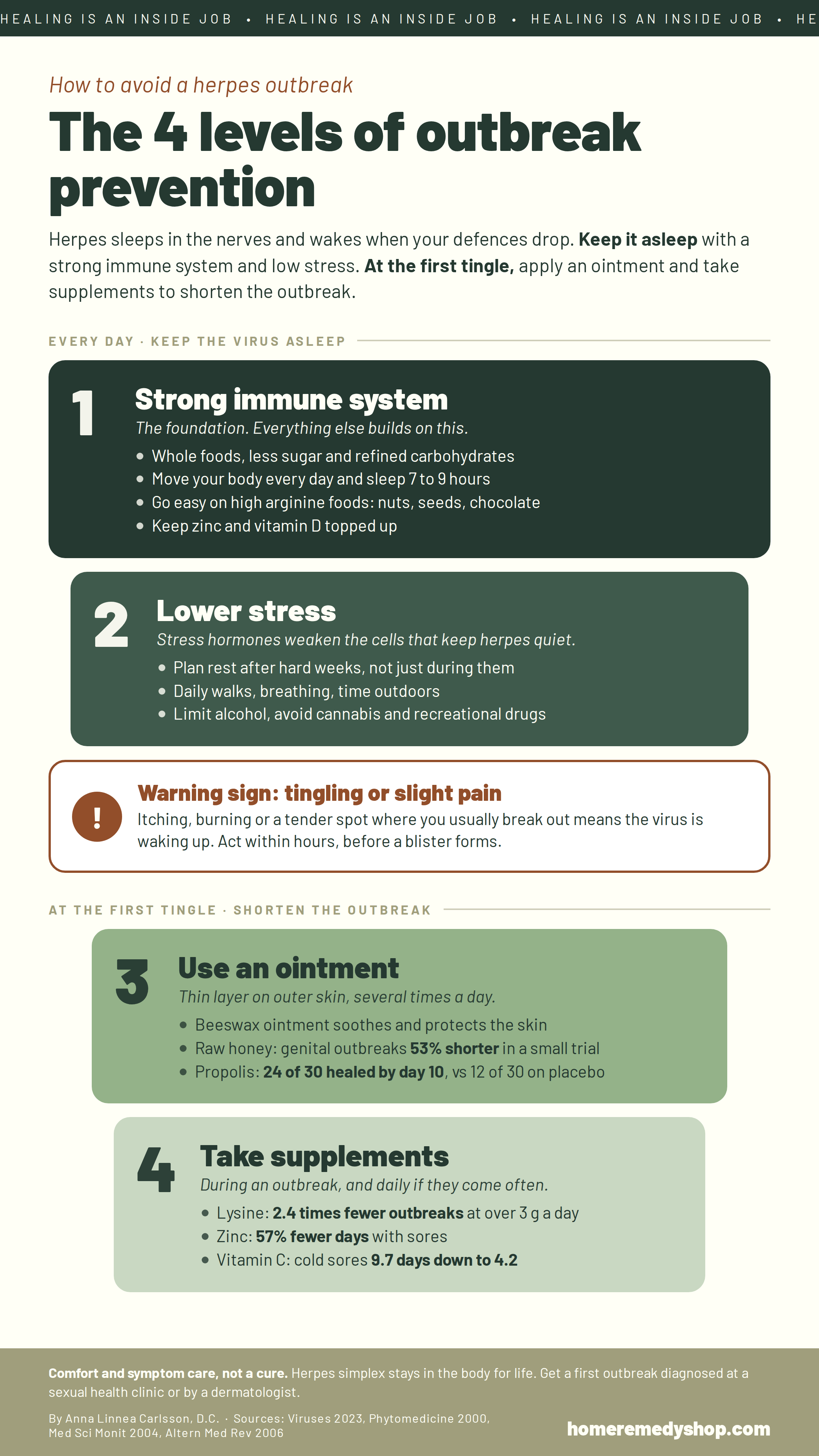
For a day by day picture of what happens next, see herpes outbreak stages and how long a herpes outbreak lasts. If the pain keeps you awake, read our tips on how to sleep during a herpes outbreak. And for everything natural that helps, from honey to lysine, start with our main guide to natural herpes remedies.
Could It Be Something Else?
Many things can look or feel like herpes, and herpes can look like many things. A first outbreak is easy to mistake for:
- Ingrown hairs or pimples, which usually have a single head and a hair in the middle
- A yeast infection, which causes itching and a thick white discharge
- A urinary tract infection, which causes burning when you pee but no sores
- Shaving rash or friction, which fades within a few days
- Canker sores, which only appear inside the mouth and aren’t contagious
- Other sexually transmitted infections, some of which also cause sores
Because of this, it’s worth getting tested rather than guessing. A swab from a fresh sore gives the clearest answer.
When to See a Doctor
- A possible first outbreak. Go to a sexual health clinic or your GP as soon as you can, ideally while the blisters are fresh, so they can take a swab. It’s the only way to know for sure, and to know which type you have.
- You can’t pee, or it’s extremely painful. See a doctor the same day.
- Severe headache, stiff neck or sensitivity to light during a first outbreak. Go to the emergency room or call emergency services. In rare cases the virus can irritate the lining of the brain.
- A painful, red or watery eye, or blurry vision, after touching a sore. See an eye doctor the same day.
- You’re pregnant and have symptoms, or your partner has herpes. Tell your midwife or obstetrician, as they’ll plan to protect your baby.
- A newborn baby with blisters, fever, poor feeding or unusual sleepiness. This is an emergency, so go to the emergency room straight away.
- Outbreaks that are very frequent, very severe or don’t heal, or a weakened immune system. See your GP or a dermatologist.
Knowing exactly what you’re dealing with is what lets you care for it the right way naturally.
Frequently Asked Questions
What are the first signs of a herpes outbreak?
Tingling, itching, burning or a sensitive patch of skin where the blisters will appear, usually a few hours to two days before. With genital herpes, some people also feel nerve pain in the lower back, buttocks or legs.
What does a first herpes outbreak feel like?
It’s often the strongest one. Many people get flu like symptoms such as fever and body aches, swollen glands in the groin, pain when peeing and clusters of painful sores that can last around two to three weeks.
Are genital herpes symptoms different in women and men?
The sores look the same, but women tend to have stronger symptoms, especially during a first outbreak. Women often get sores on the vulva and can have burning when peeing or a discharge. Men usually get sores on the penis.
Can you have herpes without symptoms?
Yes. Most people with herpes don’t notice clear symptoms, and many mistake small outbreaks for ingrown hairs, pimples or a cut. The virus can also reach the skin without any symptoms at all.
What are HSV-2 symptoms?
HSV-2 causes the same tingling, blisters and sores as HSV-1, most often in the genital area. The difference is that genital HSV-2 tends to come back more often than genital HSV-1.
How long do herpes prodrome symptoms last?
Usually a few hours to about two days. Sometimes the tingling fades without any blisters appearing.
This article is for general information and does not replace a diagnosis. Herpes can only be confirmed with a test. If you think you have herpes, see a sexual health clinic, your GP or a dermatologist.
