
Fever Blisters (Cold Sores): Causes, Stages, and Natural Remedies Backed by Research

A fever blister, also called a cold sore, is a small, fluid-filled sore caused by the herpes simplex virus (HSV), usually HSV-1. It shows up most often on or around the lips, and it is contagious from the moment you feel that first tingle until the sore has fully scabbed over and healed. There is no cure, since HSV stays in the body for life, but an outbreak, from tingle to healed skin, typically runs its course in seven to ten days, and the right care can shorten that a lot. My own go to is a beeswax ointment at the very first tingle, which in my experience clears a fever blister in about two days. The remedies with the strongest research behind them are lemon balm, peppermint oil and licorice root, alongside a well supported immune system, because a new blister is almost always the virus waking up again when your
defensesare down, not a new infection.
What Causes Fever Blisters?
Fever blisters are caused by the herpes simplex virus, most often HSV-1. Once you have been exposed, usually through close contact like kissing or sharing something that touches the mouth, the virus settles into nerve tissue and stays there permanently. It does not cause symptoms all the time. Instead, it goes dormant and reactivates now and then, and a fresh blister is almost always a reactivation of a virus you already carry, not a new exposure. Common triggers include a fever or illness (which is where the name “fever blister” comes from), sun exposure, physical or emotional stress, hormonal changes, and a weakened immune system, for example after a cold, dental work, or a run of poor sleep. We go through every trigger, and how to plan around yours, in how to avoid a herpes outbreak and cold sore triggers.
The Stages of a Fever Blister (What to Expect)
Fever blisters move through a fairly predictable cycle, and knowing which stage you’re in tells you which remedy actually helps. For a closer look at each one, see our guide to herpes outbreak stages, which has a dedicated cold sore section.
- Tingling (day 0 to 1): A tingling, itching, or burning feeling under the skin, before anything is visible. This is the single best window to start a remedy, since antiviral action works best before the virus has finished multiplying in the skin cells. It’s also the moment I reach for my beeswax ointment. If you are not sure what that first warning feels like, our guide to herpes outbreak symptoms describes the early signs.
- Blister (day 1 to 2): One or a cluster of small, fluid-filled blisters forms and becomes visibly red and swollen.
- Weeping and ulcer (day 2 to 4): The blisters break open and merge into a shallow, open sore. This is when it is most painful and most contagious.
- Crusting and scab (day 4 to 9): A scab forms over the sore as it starts to heal. It can crack and bleed if you stretch your lips, so keep it moisturized rather than letting it dry out completely. A beeswax base is ideal here, because it keeps the scab soft instead of letting it split every time you talk or eat.
- Healing (day 9 to 14): The scab flakes off and the skin underneath heals, usually without a scar.
Want to know what shortens that timeline, and what drags it out? Read how long does a herpes outbreak last.
Where Fever Blisters Show Up
Fever blisters most commonly appear on or right around the lips, but they can also show up on the chin, inside the mouth, or occasionally near the nose. A sore inside the mouth on the gums or the roof of the mouth is more often a canker sore than a fever blister (see the comparison below). If you keep getting them in the same spot, that’s typical. HSV tends to reactivate along the same nerve pathway each time. If yours appears somewhere other than the lip, our guide to a herpes outbreak on the face and the tongue covers those spots.
Are Fever Blisters Contagious, and For How Long?
Yes. A fever blister is contagious from the first tingle through to full healing, and it is most contagious while it is an open, weeping sore. The virus spreads through direct contact (kissing, oral contact) and indirect contact (sharing a cup, lip balm, or towel). HSV can also shed and spread in smaller amounts even when there is no visible sore. Doctors noticed this as far back as 1953, when they found herpes virus in the mouths of healthy adults and children with no sign of infection at all, which is part of why so many adults carry the virus without remembering a specific exposure.
Fever Blister vs. Cold Sore vs. Canker Sore: What’s the Difference?
“Fever blister” and “cold sore” are two names for the exact same thing, both caused by HSV, both appearing on or around the lips. A canker sore is different: it forms inside the mouth, not on the outer lip, is not caused by HSV, and is not contagious. If your sore is inside your cheek or on your gums rather than on the outer edge of your lip, it’s more likely a canker sore than a fever blister. Our side by side guide, cold sore or canker sore, shows you how to tell them apart at a glance.
Viral Load: Why Fever Blisters Keep Coming Back
This is the part most fever blister articles skip, and it’s the one that changed how I look after myself.
Picture two amounts of virus. The first is the virus sleeping in the nerve near your jaw. That’s its home base, and right now nothing we can buy or take reaches it. Researchers writing in Nature Communications in 2024 describe this sleeping virus as the source of every repeat outbreak. In their study, an experimental gene editing treatment removed more than 90% of it in mice, and those mice then shed far less virus. That is exciting science, but it’s years away from being something people can use.
The second amount is how often the virus wakes up and how much of it reaches your lip. That is your fever blister, and it’s also when you are most contagious. This is the part your daily care can change. A calmer virus wakes up less often and brings less of itself to the skin. That means fewer fever blisters, smaller ones, faster healing, and less chance of passing it on. The more thorough you are with an early remedy, sun protection, sleep and stress, the quieter it tends to stay. It doesn’t make the virus go away. It makes it bother you far less.
Natural Remedies for Fever Blisters (What Actually Has Research Behind It)
The remedies below are the ones with real, HSV-specific research, not just general antiseptic or folk claims. Apply any topical remedy as early as the tingling stage for the best result, and always patch test a small area first. For a head to head ranking of these and more, see our guide to the strongest natural antiviral for herpes, and for the full lip care routine, our pillar guide to home remedies for herpes on lips.
Beeswax ointment (my first choice)
I’ll start with the one I actually use on every outbreak. The moment I feel the tingle, I put on a thin layer of beeswax ointment, and in my experience the fever blister is usually gone within about two days. It doesn’t sting. The beeswax smooths over the area completely, which stops the cracking and pulling that make a fever blister so painful on moving lips.
My experience is one person’s result, so here is the research behind it. A 2025 study in Scientific Reports found beeswax extract to be strongly anti-inflammatory and antibacterial, and it slowed two other viruses in the lab. It hasn’t been tested on herpes directly yet, but it helps explain why a blister settles so quickly under it and is less likely to get infected. Propolis, which is roughly 30% beeswax, has been tested on cold sores: a 3% propolis ointment healed them in an average of 6.2 days compared with 9.8 days on a placebo, with earlier pain relief. Two reviews, one from 2022 and one from 2026, gather the wider evidence on bee products against viruses.
The one I use has oregano, clary sage and mastic oil in a beeswax and olive oil base. Oregano and sage come from the mint family, whose extracts cut herpes infection by more than 90% in the lab. Use a clean fingertip or cotton bud each time so you don’t carry virus back into the jar.
Raw honey
Honey is the other bee product with a trial behind it. In a small study, people treated one cold sore with honey and another with a standard medical cream. With honey, cold sores lasted 35% shorter and hurt 39% less, with no side effects. Only 16 people took part, so treat it as promising rather than proven. Dab on raw or medical grade honey four times a day.
Lemon balm (Melissa officinalis)
Lemon balm is the best studied herbal option for cold sores. A cream made from a concentrated lemon balm extract has been shown in a randomized, double-blind trial to reduce healing time and symptoms in recurrent herpes labialis, and separate lab research has confirmed the extract directly inhibits HSV replication. Apply a lemon balm cream or a strong, cooled lemon balm tea on a cotton ball, several times a day, starting at the first tingle.
Peppermint oil
Peppermint oil has shown a direct virucidal effect against both HSV-1 and HSV-2 in laboratory studies, meaning it can inactivate the virus itself on contact, not just soothe the skin. Dilute it in a carrier oil before applying, since it is too strong to use undiluted on broken skin. Our guide to cold sore essential oils gives safe dilutions for this and the other oils below.
Licorice root (glycyrrhizic acid)
Licorice root contains glycyrrhizic acid, which has shown antiviral activity against HSV-1 in laboratory studies. A cooled, strong licorice root tea applied on a cotton ball, or a licorice root powder made into a paste, are the traditional forms used topically.
Zinc
Topical zinc (zinc oxide or zinc sulfate preparations) has been studied specifically for herpes labialis, and people with recurrent cold sores have been found to have lower serum zinc levels than people who don’t get them, which is part of why zinc supports both topical care and the immune section below. A zinc oxide cream applied at the first sign of a blister is a reasonable, research backed option. We compared the zinc creams and other pharmacy options in cold sore remedies over the counter.
Tea tree oil
Tea tree oil has shown antiviral activity against HSV in cell culture studies, and a 6% tea tree oil gel has been tested directly in a clinical trial for recurrent herpes labialis. Always dilute it. Undiluted tea tree oil is too harsh for the delicate skin around the mouth.
Aloe vera
Aloe vera gel extract has shown antiviral activity against HSV-1 in laboratory studies, on top of its well known skin soothing effect. Use pure aloe vera gel, applied directly to the area.
Lysine
Lysine is one of the most searched for cold sore remedies, and it’s worth being honest about the evidence rather than overselling it. Some older trials found that daily lysine supplementation reduced how often outbreaks happened, but a more recent review of the research found the evidence is mixed and not strong enough to call it proven. Where it has helped, it was at higher doses: a 2023 review found under 1 g a day did little, while over 3 g a day improved how people’s outbreaks went. It’s reasonable to try alongside a remedy above, but it shouldn’t be your only strategy.
Ice
A cold compress or ice wrapped in a cloth, applied for short periods at the first tingle, won’t fight the virus itself, but it reliably reduces the swelling, redness and pain of an active blister. It’s a good first step while a remedy above starts working.
What Not to Do
- Don’t pop or pick at it. This spreads the virus to surrounding skin, raises infection risk, and slows healing.
- Skip the toothpaste. This is a very common home remedy suggestion, but there is no real research showing it fights HSV, and the ingredients that make toothpaste foam can actually irritate broken skin and slow healing down.
- Skip the hydrogen peroxide. It’s a general antiseptic, not an antiviral, and it can damage the healthy skin cells around the sore that are trying to heal.
- Don’t let it dry out and crack. A cracked scab reopens the sore and adds days. Keep it soft with a beeswax based balm.
Is a Fever Blister the Same Thing as Herpes?
Yes. A fever blister is a herpes simplex outbreak, almost always HSV-1. This surprises people because “herpes” is so often used to mean only the sexually transmitted form, but HSV-1 (oral, causing most fever blisters) and HSV-2 (genital) are two strains of the same virus family, and either one can appear in either location. What decides how often it comes back is not which strain you have but how active the virus is allowed to be, the viral load idea explained above. The full picture of how the immune system keeps HSV in check, and when it can’t, is covered in our herpes home remedies guide. If you also get outbreaks in the genital area, our guide to genital herpes outbreak treatment at home applies the same approach there.
Boost Your Immunity and Lower Your Stress
An outbreak is your immune system momentarily losing ground against a virus it otherwise keeps dormant. Research on the immune response to HSV shows that both your innate immune response (the body’s first, fast acting line of defence) and your adaptive immune response (built through prior exposure, largely carried by a specific type of T cell) work together to control the virus, and it’s a coordinated balance between the two, not any single mechanism, that keeps HSV suppressed. That is the immune system doing its job of keeping the virus quiet, which is exactly why anything that weakens that response, illness, poor sleep, and especially stress, tends to line up with a new outbreak.
The stress connection isn’t just a feeling. A landmark study found that psychological stress can directly trigger the reactivation of dormant HSV-1, and a later analysis pooling multiple studies confirmed that psychosocial stress reliably predicts HSV recurrence. Stress hormones weaken the very immune cells that keep herpes in check, which is one reason outbreaks so often follow a hard week.
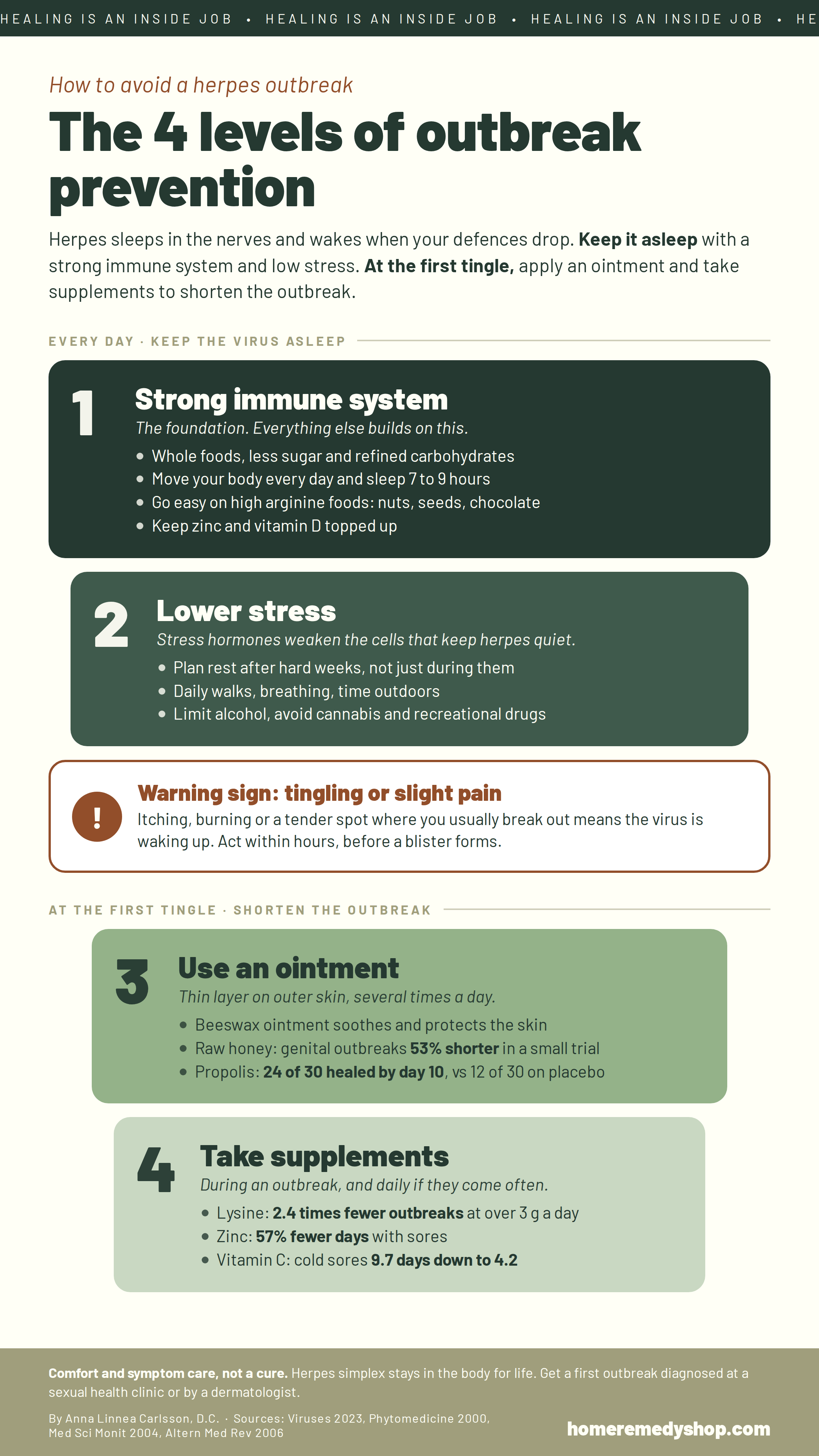
In practice, that means:
- Protect your sleep. Poor sleep is one of the most consistent immune suppressors, and it’s one of the few triggers almost fully within your control. If a throbbing blister is what’s keeping you up, our guide on how to sleep during a herpes outbreak has practical tips.
- Build in real stress recovery, not just less stress. Short daily practices, a walk outside, slow breathing, time away from screens, matter more for immune resilience than trying to remove every stressful thing from your life.
- Support your gut and overall nutrition. A large share of immune activity is tied to gut health, so a diet with enough protein, zinc and vitamin C gives your immune system the raw materials it needs.
- Protect your lips from the sun. Sun exposure is one of the best known fever blister triggers, so wear an SPF lip balm outdoors, at the beach and on the slopes.
- Keep your ointment within reach. I keep my beeswax ointment in my bag, because the difference between putting it on at the first tingle and putting it on the next morning is the difference between a two day blister and a full week one.
- Notice your personal pattern. Many people can look back and see a stressful week, a cold, or a bad stretch of sleep right before their last two or three outbreaks. Once you know your pattern, you can start a remedy the moment you feel the first tingle, or even before, during a period you know is high risk.
When to See a Doctor
If this is the first time you’ve had a sore like this, or if you’re not sure whether what you’re dealing with is a fever blister, a canker sore, or something else, it’s worth getting it properly diagnosed before treating it. A dermatologist can confirm HSV with a simple swab of a fresh blister, which is what lets you know you’re treating the right thing. It’s also worth a visit if outbreaks are frequent (more than five or six a year), if a sore hasn’t started healing within two weeks, or if you have a weakened immune system. A sore near your eye, or a red, painful or watering eye, needs an eye doctor the same day, since herpes in the eye can damage vision. And if a baby or young child develops sores around the mouth, contact your paediatrician straight away.
What I put on every fever blister
This handmade beeswax ointment with oregano, clary sage and mastic oil is what I reach for at the first tingle. In my experience it clears a fever blister in about two days, and it never stings. Nobody pays me to recommend it. I recommend it because it works for me.
Frequently Asked Questions
What causes fever blisters?
Fever blisters are caused by the herpes simplex virus, usually HSV-1. Once you’ve been exposed, the virus stays dormant in nerve tissue and reactivates when something like illness, sun exposure, stress, or a weakened immune system gives it the opening.
What are the stages of a fever blister?
Tingling, then a blister, then a weeping open sore, then a scab, then healed skin. The whole cycle usually takes seven to ten days, and the earlier you start a remedy in that cycle, the more it can shorten it. Each stage is explained in our guide to herpes outbreak stages.
What do fever blisters look like?
Small, clustered, fluid-filled blisters on a red, swollen base, most often right on or beside the lip line. They break open into a shallow sore before scabbing over.
Are fever blisters contagious, and when?
Yes, from the first tingle until the sore is fully healed, and most contagious while it’s an open sore. Avoid kissing, sharing drinks, towels, or lip products during that window.
How long do fever blisters last?
About seven to ten days from the first tingle to fully healed skin, though a remedy started early, at the tingling stage, can shorten that. With a beeswax ointment at the first tingle, mine are usually gone in about two days.
Is a fever blister the same thing as herpes?
Yes. A fever blister is a herpes simplex outbreak, almost always the HSV-1 strain. See our herpes home remedies guide for the fuller picture.
What’s the difference between a fever blister and a cold sore?
Nothing. They’re two names for the same thing.
What’s the difference between a canker sore and a fever blister?
A canker sore forms inside the mouth and isn’t caused by HSV or contagious. A fever blister forms on the outer lip, is caused by HSV, and is contagious. See our canker sore guide for more on treating them.
Can stress cause a fever blister?
Yes. Research has directly linked psychological stress to HSV reactivation, which is why supporting your sleep and stress levels matters as much as any topical remedy.
Why do fever blisters keep coming back?
Because the virus sleeps in a nerve near your jaw for life and wakes up when your
defensesdrop. You can’t remove the sleeping virus, but a strong immune system, low stress and early care keep it waking up less often and with less virus each time, so blisters become rarer and milder.
What’s the fastest way to get rid of a fever blister?
Start a remedy at the very first tingle, before the blister has even formed. That timing is the single biggest factor in how fast it resolves. My own choice is a beeswax ointment, which usually clears mine in about two days, and lemon balm, peppermint oil and licorice root are the best studied herbal options.
This article is for comfort and symptom care and does not replace a diagnosis. Herpes simplex stays in the body for life. If you’re unsure whether you’re dealing with a fever blister, see the “When to See a Doctor” section above.
