
How to Get Rid of Cold Sores: Causes, Stages and Natural Remedies
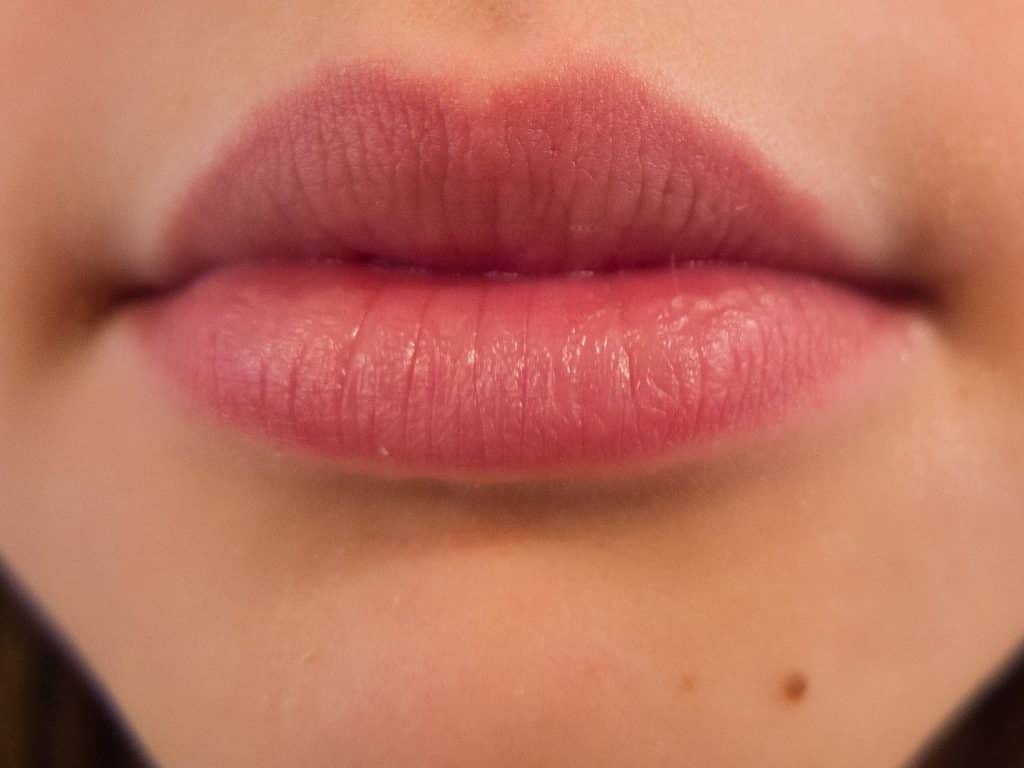
A cold sore is a small cluster of fluid-filled blisters on or around the lips, caused by the herpes simplex virus, usually HSV-1. Most cold sores heal in one to two weeks, and the fastest way to get rid of one is to start treating it at the very first tingle, before the blister forms. My own go to is a beeswax ointment, which in my experience clears a cold sore in about two days. But if cold sores come back year after year, the real answer is not in any jar. It sits in how you handle stress and how you look after your health between outbreaks, because that is what decides how often the virus wakes up at all.
This guide covers everything: what causes cold sores, how to prevent them, the stages and how long each lasts, when a cold sore is contagious, and the natural remedies that have real research behind them.
The short version
- At the first tingle, apply a beeswax ointment, raw honey, or a lemon balm or propolis cream several times a day.
- Don’t pop it, don’t pick it, and don’t share cups, towels or lip balm.
- Take lysine and go easy on sugar, nuts and chocolate until it heals.
- If cold sores keep coming back, look at your stress patterns and your everyday health, not just the sore.
What Is a Cold Sore?
A cold sore is an outbreak of the herpes simplex virus on the skin, most often on the edge of the lip. It is the same thing as a fever blister, just a different name. And yes, a cold sore is herpes: it is the oral form of the virus, also called herpes on lips. That word scares people, but the virus is extremely common. The WHO estimates that around two thirds of people under 50 worldwide carry HSV-1, and many of them never know it.
Once you have the virus, it never fully leaves. After the first infection it travels up a nerve and sleeps in a nerve cluster near the jaw. A 2023 review of natural treatments describes this as a latent infection that usually stays for life. A new cold sore is almost never a new infection. It is the same sleeping virus waking up again.
What Causes Cold Sores?
So how do you get a cold sore in the first place? The virus spreads through close contact: kissing, sharing a cup, a fork, a towel or a lip balm with someone who is shedding it. Doctors found as far back as 1953 that herpes virus can be present in the mouths of healthy adults and children with no visible sore at all, which is why most people can’t remember when they caught it. Many first catch it as young children.
After that, what causes a cold sore on the lip is whatever lowers your defences enough for the sleeping virus to wake up. The most common triggers, listed in a review of natural remedies for herpes simplex, are:
- Stress, both emotional and physical
- Tiredness and poor sleep
- A cold, flu or fever, which is where the names “cold sore” and “fever blister” come from
- Sun exposure on the lips
- Chapped, cracked or injured lips, including after dental work
- Menstruation and other hormonal shifts
For a full breakdown of triggers and how to plan around yours, see how to avoid a herpes outbreak.
Can Stress Cause Cold Sores? Why Self-Connection Comes First
Yes, and this is the part I want you to take seriously. A landmark study found that psychological stress can directly reactivate sleeping HSV-1, and a later analysis pooling several studies confirmed that stress predicts herpes outbreaks. Stress hormones weaken the very immune cells that keep the virus quiet, which is one reason cold sores so often follow a hard week.
Here is my perspective. If cold sores really bother you year after year, or season after season, the first thing to work on is not a remedy. It is your self-awareness and self-connection. There is most likely a stress pattern you keep repeating, or keep letting happen in your environment. Maybe it’s the same deadline crunch every spring, the same family tension every holiday, the same way you say yes to too much and never rest. Without fully facing that pattern and becoming aware of it, your stress keeps peaking in the same places, and every peak leaves you more open to a cold sore.
Self-connection means noticing what is happening in you before your lip tells you. A few ways to start:
- Look back at your last few cold sores. What was going on in the week before each one? Most people find the same kind of situation every time.
- Name the pattern. Is it overwork, conflict you avoid, people you can’t say no to, a season you dread?
- Check in with your body daily. Tight jaw, shallow breathing, bad sleep: these show up long before a tingle does.
- Change one thing in your environment, not everything. A boundary, a rest day, a walk alone.
If the pattern feels bigger than you can untangle on your own, a psychologist or a therapist who works with stress can help you see it clearly. Self-connection can be the first step to breaking the cold sore pattern for good.
Why Home Remedies Alone Won’t Stop Cold Sores Coming Back
This is my second, and maybe most important, point: there is truly no home remedy that will solve your cold sores if you don’t take care of your health outside the days a cold sore affects you. Health is a continuous effort, not something you switch on when your lip starts tingling.
Here is why, in plain terms. Think of the virus in two amounts. The first is the virus sleeping in your nerve. Nothing available today reaches it. Researchers writing in Nature Communications in 2024 describe that sleeping virus as the source of every repeat outbreak, and only an experimental gene editing treatment, tested in mice, has managed to shrink it so far.
The second amount is your viral load: how often the virus wakes up and how much of it reaches your skin. This is the part you can change. A calmer virus wakes less often and brings less of itself to your lip, and that means fewer cold sores, smaller ones, faster healing, and less chance of passing it on. The virus can even be active on the skin without a sore. A study that swabbed people with genital herpes daily found virus on the skin on about 1 in 5 days, often with no sore at all. The same quiet waking up happens with oral herpes.
To keep that viral load low, you have to help your immune system battle the virus every day, through:
- Movement. Daily movement you enjoy, walking, swimming, yoga, keeps your body and your stress levels in balance. It doesn’t need to be intense. It needs to be regular.
- Food. Whole foods, enough protein, and less sugar and refined carbohydrates, which the 2023 review links to flare ups. Keep zinc and vitamin D topped up: people with recurrent cold sores tend to have lower zinc levels, and low vitamin D has been linked to higher herpes rates.
- Environment. The people, places and pace you live in. This ties straight back to self-connection above.
- Sleep. Research on the immune response to HSV shows that the body keeps the virus down through a coordinated balance of first line and long term immune defences, and that balance depends on rest.
How to Prevent Cold Sores
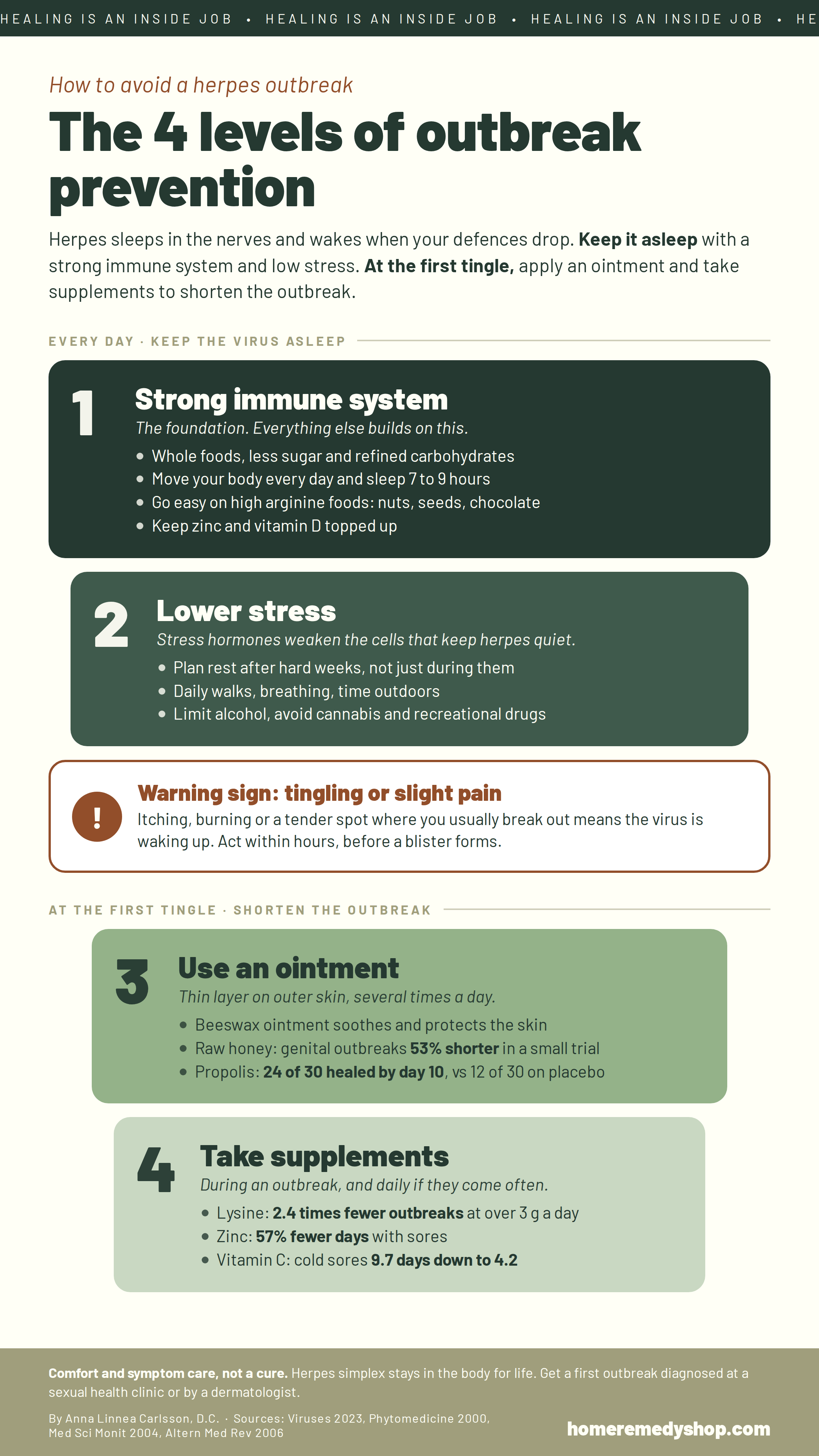
Putting it together, prevention of cold sores comes down to these habits:
- Know your stress pattern and deal with it before it peaks.
- Move, eat well and sleep every week, not just during an outbreak.
- Protect your lips from the sun with an SPF lip balm outdoors, at the beach and on the slopes.
- Keep your lips from chapping in wind and cold with a rich balm. A beeswax base works well, or make your own lip balm.
- Eat lysine rich foods like fish, chicken, eggs, yogurt and cheese, and go easy on high arginine foods like nuts, seeds and chocolate when you feel run down.
- Don’t share cups, cutlery, towels, razors or lip products.
- Keep your remedy within reach so you can act at the very first tingle.
Symptoms of a Cold Sore and the Stages
How do you know if you have a cold sore? The symptoms of a cold sore start before anything is visible. Most people feel a tingling, itching or burning spot on the lip a day before the blister shows. That early warning is when a cold sore is starting, and it’s the best moment to act. The first outbreak can also come with fever, sore gums and swollen glands. For every early sign, see herpes outbreak symptoms.
After that, a cold sore goes through five stages:
- Tingling (day 1): itching or burning under the skin. Start your remedy now.
- Blistering (days 2 to 3): small fluid-filled blisters appear, usually in a cluster on the edge of the lip.
- Weeping (day 4): the blisters burst into a shallow, painful open sore. This is when it’s most contagious.
- Crusting (days 5 to 8): a yellow or brown scab forms. Keep it soft so it doesn’t crack and bleed.
- Healing (days 8 to 14): the scab falls off and the skin underneath heals, usually without a scar.
That is the whole cold sore recovery process. For a closer look at each phase, with a dedicated cold sore section, read our guide to herpes outbreak stages.
How Long Will a Cold Sore Last?
Left alone, a cold sore usually lasts 7 to 14 days from the first tingle to healed skin. A first ever outbreak can take up to three weeks. Starting a remedy at the tingling stage can shorten that a lot: with a beeswax ointment at the first tingle, mine are usually gone in about two days. For what speeds healing up and what drags it out, see how long a herpes outbreak lasts.
Is a Cold Sore Contagious, and When Is It Not?
A cold sore is contagious from the first tingle until the skin has completely healed, and it’s most contagious when the blister has burst and is weeping. It is no longer contagious once the scab has fallen off and the skin underneath is fully closed, usually after one to two weeks. Even then, the virus can occasionally shed without any sore, so it’s wise to avoid kissing newborns at any time.
While you have one:
- Don’t kiss anyone, and never kiss a baby. Read cold sores in babies and newborns to understand why this matters so much.
- Don’t share cups, cutlery, towels, razors or lip products.
- Wash your hands after touching your lip, and never touch your eyes afterwards.
- Avoid oral sex until it’s fully healed. The oral virus can spread to the genitals. Our guide to genital herpes outbreak treatment at home covers that side.
Where Cold Sores Show Up
Most cold sores appear on the outer edge of the lip, but they can also show up on the side of the mouth, under or inside the nose, on the chin, and less often on the gums or the roof of the mouth. A cold sore inside the mouth is less common than people think, and a sore there is often something else. We cover the unusual spots in herpes on the face and the tongue.
Is It a Cold Sore or Something Else?
Plenty of lip bumps are not cold sores:
- Canker sores form inside the mouth, aren’t caused by a virus and aren’t contagious. See cold sore or canker sore for how to tell them apart.
- A pimple or lip zit has a single white head, no tingling beforehand, and usually sits just off the lip line.
- Angular cheilitis is cracked, sore corners of the mouth, often fungal. See our natural remedies for angular cheilitis.
- Chapped lips peel and crack across the lip, without blisters.
If you’re not sure, get it checked before you treat it. Treating the right thing is what makes natural care work.
How to Get Rid of a Cold Sore Faster: Natural Remedies That Work
The remedies below have research on the herpes virus behind them. Apply any topical remedy at the tingling stage for the best result, use a clean fingertip or cotton bud each time, and patch test first. For a head to head ranking, see our guide to the strongest natural antiviral for herpes.
1. Beeswax ointment (my first choice)
I use a beeswax ointment on every cold sore. The moment I feel the tingle I put on a thin layer, and in my experience it’s usually gone within about two days. It doesn’t sting. The beeswax smooths the blister over completely, which stops the cracking and pulling that make a cold sore so painful on moving lips.
That’s one person’s experience, so here’s the research. A 2025 study in Scientific Reports found beeswax extract to be strongly anti-inflammatory and antibacterial, and it slowed two other viruses in the lab. It hasn’t been tested on herpes directly yet, but it helps explain why a sore settles quickly under it and is less likely to get infected. Reviews from 2022 and 2026 gather the wider evidence on bee products against viruses. The one I use also contains oregano and sage oils, from a plant family whose extracts cut herpes infection by more than 90% in the lab.
2. Propolis
Propolis is the resin bees make, and it’s roughly 30% beeswax. In a placebo controlled trial, a 3% propolis ointment healed cold sores in an average of 6.2 days compared with 9.8 days, with earlier pain relief. Skip it if you’re allergic to bee products.
3. Raw honey
In a small trial, people treated one cold sore with honey and another with a standard medical cream. With honey, cold sores lasted 35% shorter and hurt 39% less, with no side effects. Only 16 people took part, so treat it as promising rather than proven. Dab on raw or manuka honey four times a day.
4. Lemon balm
Lemon balm is one of the best studied herbal remedies for cold sores. A cream made from lemon balm extract reduced symptoms of recurring cold sores within two days in a double blind trial, and lab research shows the extract blocks herpes virus from multiplying. Apply a lemon balm cream, or a strong cooled lemon balm tea on a cotton ball, from the first tingle.
5. Tea tree oil and peppermint oil
Tea tree oil has shown antiviral activity against herpes simplex in the lab, and a 6% tea tree oil gel was tested in a clinical trial on recurrent cold sores. Peppermint oil inactivated both herpes types on contact in lab studies. Chamomile, thyme and ginger oils also reduced herpes virus by more than 90% in the lab. Never use any of these undiluted on your lips. Which oils to choose and how to dilute them safely is covered in essential oils for cold sores.
6. Licorice root
Licorice root extract has shown antiviral activity against HSV-1 in the lab. A cooled, strong licorice root tea on a cotton ball, or licorice powder made into a paste, are the traditional ways to use it on the skin.
7. Aloe vera gel
Aloe vera gel extract showed activity against HSV-1 in a lab study, on top of its well known soothing effect. Use pure gel straight from the leaf or a pure store bought gel.
8. Zinc
A zinc oxide and glycine cream shortened cold sores and eased blistering, soreness and itching compared with a placebo in a randomised trial. Taken by mouth, zinc halved the number of cold sores in a small group of people who got them often. You’ll also find zinc in some pharmacy products, which we compared in cold sore remedies over the counter.
9. Lysine supplements and lysine rich foods
Lysine works against arginine, which the virus needs to multiply. In one six month trial, people taking lysine had 2.4 times fewer outbreaks, and doses above 3 g a day helped where under 1 g did not. An older trial of lysine for recurrent herpes found similar benefits, but a review of the evidence calls the overall picture mixed. So how much lysine should you take for cold sores? The studies that worked used over 3 g a day. Check with a pharmacist first if you have kidney problems or take regular medication.
10. Vitamin C and vitamin E
In a double blind trial, vitamin C with bioflavonoids shortened cold sores from 9.7 days to 4.2 days. Dabbing vitamin E oil on the sore every few hours brought quick pain relief in a study of 50 people with cold sores.
11. Ice
Does ice help cold sores? It won’t touch the virus, but a cold compress or an ice cube wrapped in a cloth, held on for a few minutes at a time, reliably eases swelling, redness and pain. It’s a good first step while a remedy starts working.
12. Petroleum jelly and lip balm
Petroleum jelly doesn’t fight the virus, but a thin layer keeps a healing cold sore from drying out and cracking. A beeswax based lip balm does the same job, and an SPF lip balm protects against sun triggers once it’s healed.
What Kills Cold Sores Instantly?
Honestly, nothing. No remedy, natural or from the pharmacy, kills a cold sore instantly, because the virus behind it lives in your nerve, not just on your lip. What gets rid of a cold sore fastest is timing: starting a remedy at the first tingle, before the blister forms. That’s the difference between a sore that’s gone in two days and one that lasts two weeks. You’ll also find people asking how to get rid of a cold sore overnight. The same answer applies: act early, keep it soft and clean, and rest.
What About Homeopathic Remedies?
Homeopathic cold sore remedies are popular, but there is no clinical research showing they work on the herpes virus. We look at the most common ones, and what the evidence really says, in homeopathic remedies for cold sores.
What Not to Do
- Don’t pop a cold sore. Should you pop a cold sore? No. Popping spreads the virus to the surrounding skin, your fingers and your eyes, invites infection, and makes it heal slower.
- Don’t put toothpaste on it. There’s no research showing it fights the virus, and it can irritate broken skin.
- Skip hydrogen peroxide, alcohol and nail polish remover. They dry and damage the healthy skin that’s trying to heal, and none of them is an antiviral.
- Don’t let it crack. A cracked scab reopens the sore and adds days. Keep it soft.
Comfort While It Heals
- Avoid salty, spicy and acidic foods like crisps, citrus and tomato sauce, which sting.
- Drink through a straw.
- Use a separate towel and pillowcase, and wash them hot.
- Rest. If the throbbing keeps you up, see how to sleep during a herpes outbreak.
When to See a Doctor
Get your first cold sore, or any sore you’re not sure about, checked by a dermatologist. A swab of a fresh blister confirms it, so you know you’re treating the right thing. See an eye doctor the same day if you have a sore near your eye, or a red, painful or watering eye, since herpes in the eye can damage vision. If a baby or young child has sores around the mouth, contact your paediatrician straight away. Also get checked if cold sores spread across your face or body, especially with eczema, if they come more than five or six times a year, if one hasn’t healed in two weeks, or if your immune system is weakened.
What I put on every cold sore
This handmade beeswax ointment with oregano, clary sage and mastic oil is what I reach for at the first tingle. In my experience it clears a cold sore in about two days, and it never stings. Nobody pays me to recommend it. I recommend it because it works for me.
Frequently Asked Questions
How do you get rid of a cold sore fast?
Start a remedy at the very first tingle, before the blister forms. A beeswax ointment, propolis, honey or lemon balm cream applied several times a day gives the best result. With beeswax at the first tingle, mine are usually gone in about two days.
What kills cold sores instantly?
Nothing kills a cold sore instantly. The virus lives in your nerve for life. Treating early is what makes a cold sore heal fastest.
How long will a cold sore last?
Usually 7 to 14 days without treatment, and up to three weeks for a first outbreak. Starting a remedy at the tingling stage can shorten it to a few days.
How do you get a cold sore?
You catch the herpes simplex virus through close contact such as kissing or sharing cups and lip products, often in childhood. After that, cold sores appear when stress, illness, sun, tiredness or hormonal changes wake up the sleeping virus.
Can stress cause cold sores?
Yes. Research shows stress can directly reactivate the herpes virus. If cold sores come back every year or every season, look for the stress pattern behind them. Self-connection is the first step to breaking it.
When is a cold sore not contagious?
Once the scab has fallen off and the skin underneath has fully healed, usually after one to two weeks. It’s most contagious while the blister is open and weeping.
Is a cold sore herpes?
Yes. A cold sore is oral herpes, usually HSV-1. It’s extremely common, and most people carry the virus. Read more about herpes on lips.
Should I pop a cold sore?
No. Popping spreads the virus, risks infection and slows healing. Keep it covered with a soothing ointment instead.
Can I put petroleum jelly on a cold sore?
Yes, as a protective layer. It won’t fight the virus, but it stops the sore from cracking while it heals.
How can you prevent cold sores?
Work on your stress patterns, move daily, eat well, sleep enough, protect your lips from the sun and wind, and keep your remedy close so you can act at the first tingle. Taking care of your health between outbreaks is what keeps the virus quiet.
This article is for comfort and symptom care and does not replace a diagnosis. Herpes simplex stays in the body for life. If you’re unsure whether you’re dealing with a cold sore, see the “When to See a Doctor” section above.
