
Genital herpes outbreak treatment at home
Key points
- Genital herpes is lifelong; natural care is comfort, not a cure: The virus remains in the body, but thorough natural care can shorten, calm, and reduce the frequency of outbreaks, improving quality of life without eliminating the infection.
- Immediate actions for outbreak management: Keep the area clean and dry, apply beeswax ointment or raw honey externally, start lysine, limit high-arginine foods, rest and manage stress, and obtain a swab test if it’s a first outbreak or during pregnancy.
- Viral load: why outbreaks recur and how care helps: The virus hides in nerve clusters and reactivates to the skin; while sleeping virus cannot be removed, reducing the amount that wakes and reaches the skin can lessen outbreak frequency and contagion.
- Beeswax, honey, propolis and related remedies with evidence: Beeswax provides anti-inflammatory benefits; propolis and honey have shown antiviral activity in studies, with propolis shorting recurrence and honey reducing outbreak duration and pain when used on external skin.
- Lifestyle and preventive measures to lower outbreaks: Manage stress, protect sleep, take daily lysine, reduce sugar, limit alcohol, minimize friction, maintain zinc and vitamin D, and act at the first tingle to keep the virus quiet.
Introduction
If you are in the middle of an outbreak right now, you want two things: for the pain to stop, and for it to heal fast. Then you want to know how to keep the next one from coming back so soon. This guide covers both, using natural remedies that have actually been tested on people with herpes, not just repeated online.
One thing first, because it matters for everything below. Herpes simplex is a lasting virus. Nothing on this page, natural or medical, removes it from the body. What natural care can do is make outbreaks shorter, calmer and less frequent. That is comfort and symptom care, and done thoroughly, it can change how much herpes affects your life.
The short version: what to do today
- Keep the area clean, dry and covered with loose cotton underwear.
- Apply a thin layer of a beeswax ointment or raw honey to the outside skin, several times a day.
- Start lysine and cut back on sugar, alcohol and high arginine snacks like nuts and chocolate for now.
- Rest. Sleep and lower stress are part of the treatment, not a luxury.
- If this is your first outbreak, or you are pregnant, get it swabbed by a sexual health clinic first.
First, make sure you know what you are treating
Painful blisters or sores in the genital area are not always herpes. Ingrown hairs, friction, fungal infections and other infections can look similar at first. Natural care works best when you know exactly what you are dealing with, so if you have never had a confirmed diagnosis, get one.
The most useful place to go is a sexual health clinic (a GUM clinic in the UK, or the sexual health service at your local hospital), a gynaecologist or a urologist. They can swab a fresh sore, which is the most reliable test, ideally within the first two days of a blister appearing. A general check without a swab often cannot tell you for sure.
If you are not sure what an outbreak normally looks and feels like, our guide to herpes outbreak symptoms walks through the early warning signs, from tingling to the first blisters.
Viral load: the one idea that explains why outbreaks come back
This is the part most pages skip, and it is the key to understanding what you can and cannot change.
Where the virus lives
After the first infection, the herpes virus does not stay on the skin. It travels up the nerves and settles in a nerve cluster near the spine. There it sleeps, and in that sleeping state the body cannot clear it. A 2023 review of natural herpes treatments describes this as a latent infection that typically stays for life. Researchers writing in Nature Communications in 2024 explain that this sleeping virus is the source of every repeat outbreak, and that no current treatment, medical or natural, reaches it.
So what is “viral load”?
Think of it as two amounts of virus:
- How much virus is sleeping in the nerves. This is your home base. Right now, nothing you can buy or take lowers it. The same 2024 study showed that an experimental gene editing treatment removed up to 97% of the sleeping virus in mice, and that those mice then shed far less virus. That is exciting science, but it is years away from people.
- How often the virus wakes up and how much of it reaches the skin. When it wakes, it travels back down the nerve and multiplies on the skin. That is the outbreak, and it is also when you are most contagious. This is the part your daily care can influence.
Why this matters even when you have no symptoms
The virus can wake up quietly. A large JAMA study that swabbed 498 people with genital herpes every day found that people with symptoms had virus on their skin on about 1 in 5 days, often with no sore at all. Days with visible sores carried the highest amounts. Doctors noticed the same thing back in 1953, when they found herpes virus in the mouths of healthy people with no sign of infection at all.
Here is what that means for you in plain terms. A calmer virus wakes up less often and brings less of itself to the skin. That means fewer outbreaks, shorter outbreaks, less pain, and less chance of passing it on. The more thorough and consistent your care is, with remedies, diet, sleep and stress all working together, the quieter the virus tends to stay. It does not make the virus go away. It makes it matter much less.
How long an outbreak lasts, and what each stage feels like
Most repeat outbreaks follow the same path: tingling or itching, then small blisters, then open sores, then crusting and healing. Knowing the stages of a herpes outbreak helps you start care at the right moment, because remedies work best in the tingling stage, before blisters form.
A first outbreak is usually the longest and most painful. Repeat outbreaks tend to be shorter and milder. We break down the typical timeline, and what can shorten it, in how long does a herpes outbreak last.
Beeswax: the first thing I reach for
If there is one product I would tell you to keep in the cupboard, it is a good beeswax ointment. I use it myself on every outbreak. I put it on as soon as I feel it coming, and in my experience it is usually gone within about two days. It does not sting. The beeswax simply smooths over the area, and the relief is quick.
The one I use is the Aromafisis beeswax ointment with oregano. It is handmade from olive oil, beeswax, oregano oil, clary sage oil and mastic oil, with no preservatives. I am not paid to mention it. I recommend it because it works for me.
What the research says about beeswax and bee products
My experience is one person’s result, so here is what the studies show.
- Beeswax calms inflamed skin and fights germs. A 2025 study in Scientific Reports found beeswax extract was strongly anti-inflammatory and antibacterial, and it slowed two other viruses in the lab. It was not tested on herpes itself, but it helps explain why broken skin settles quickly under it, and why sores are less likely to get infected.
- Bee products have real antiviral activity. Two reviews, one from 2022 and one from 2026, gathered the evidence on honey, propolis and beeswax against viruses, including herpes.
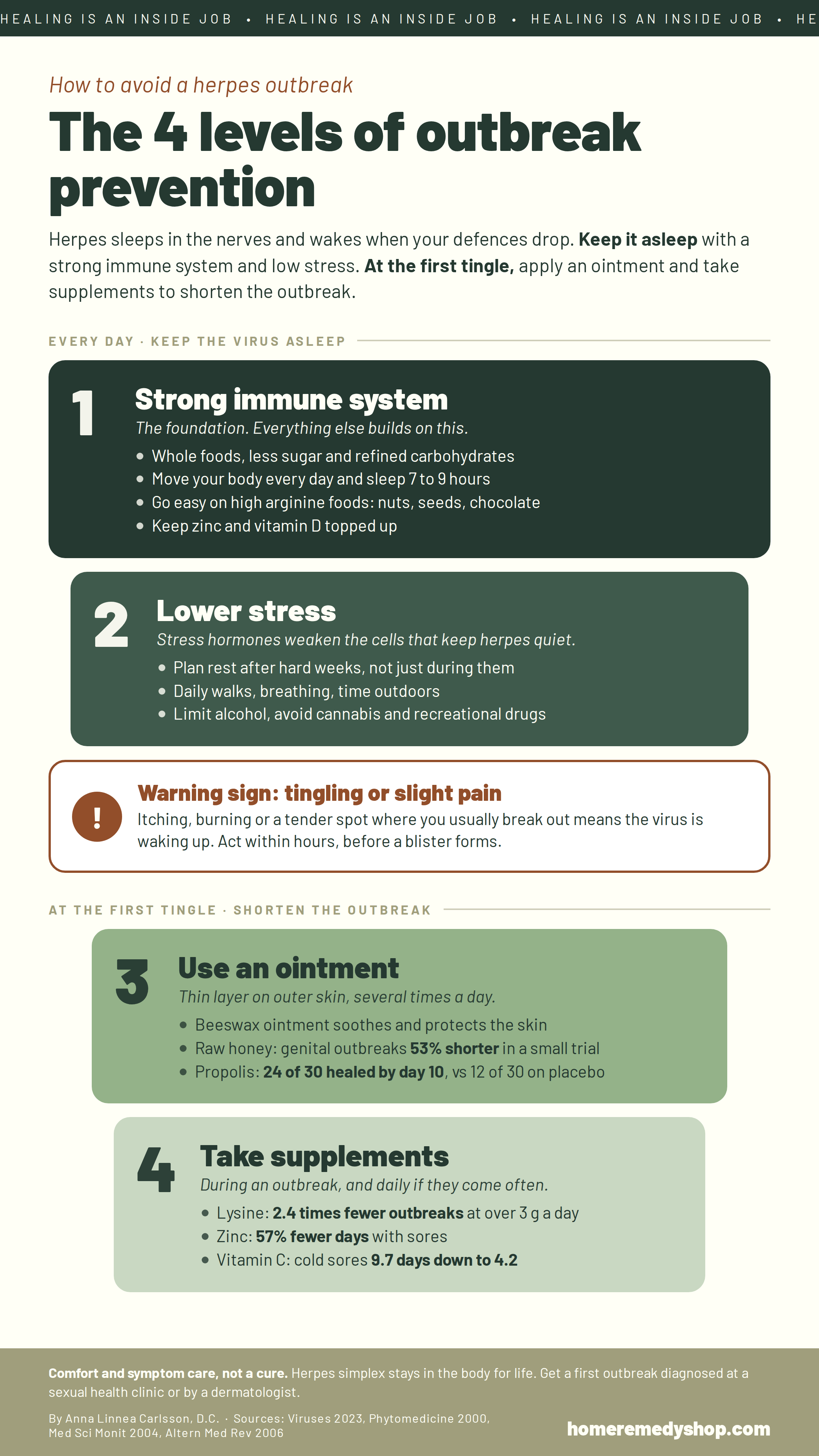
- Propolis, which is about 30% beeswax, healed genital herpes faster in a trial. In a study of 90 people with repeat genital herpes, 24 of 30 people using propolis ointment had healed by day 10, compared with 12 of 30 using a placebo.
- The oregano and sage in the ointment belong to a plant family with anti herpes activity. Extracts from this mint family, including lemon balm, sage and thyme, cut herpes infection by more than 90% in the lab.
How to use it: wash and dry your hands, then apply a thin layer to the outside skin several times a day, starting at the first tingle. Keep it to external skin, and as with any product containing plant oils, try a small spot first. Use a clean finger or cotton bud each time so you do not carry virus back into the jar.
Other natural remedies with research behind them
These are the remedies with the best evidence from studies on actual herpes patients. For a deeper comparison of which works hardest, see our guide to the strongest natural antiviral for herpes.
Raw honey
In a small trial, people applied honey to one outbreak and a standard medical cream to another. On genital sores, honey shortened the outbreak by about half and cut pain by 50%, and no one had side effects. It was only 16 people, so treat it as promising rather than proven, but it is cheap and gentle. Use raw or medical grade honey on external skin only.
Propolis
Besides the genital trial above, a review of natural treatments concluded that propolis can help keep herpes outbreaks from returning. Look for an ointment of around 3% propolis. Skip it if you are allergic to bee products.
Lysine
Lysine is an amino acid that works against arginine, which the virus needs to multiply. In one six month trial, people taking lysine had 2.4 times fewer outbreaks than those on a placebo. The same review found doses under 1 g a day did little, and doses above 3 g a day helped. If you have kidney problems or take regular medication, check with a pharmacist before starting.
Zinc
In a small study of people with repeat genital herpes, daily zinc cut the number of days with sores by 57%. Topical zinc solutions also sped up healing in older trials. Zinc works best as a steady daily habit rather than a last minute fix.
Lemon balm and vitamin E
Lemon balm cream is best studied on cold sores, where it clearly helped, and the lab research shows it works against both herpes types. A little vitamin E oil dabbed on sores has been reported to ease pain within hours. Both are gentle options for external skin.
A note on essential oils
Hyssop, thyme, ginger, chamomile and sandalwood oils all reduced genital herpes virus by more than 90% in the lab. That is a lab result, not a human trial, and undiluted oils can burn delicate genital skin. Only use them well diluted in a carrier like beeswax or olive oil, on external skin. We cover safe blends in our guide to cold sore essential oils, and the same dilution rules apply here.
Comfort care while you heal
- Wear loose cotton and avoid tight jeans or synthetic underwear, which trap heat and rub.
- Keep sores dry. Pat dry after washing, or use a hairdryer on a cool setting.
- If passing urine stings, pour lukewarm water over the area while you go, or sit in a shallow lukewarm bath.
- Avoid touching the sores, and wash your hands after applying anything.
- Avoid sexual contact from the first tingle until the skin has fully healed.
- Rest properly. If the pain or itch keeps you awake, our guide on how to sleep during a herpes outbreak has practical positions and night routines that help.
How to avoid the next outbreak: the takeaways
This is where lowering viral load really happens. Every habit below helps keep the sleeping virus sleeping. The full list of triggers, and how to plan around them, is in how to avoid a herpes outbreak.
- Manage stress. Stress hormones weaken the immune cells that keep herpes in check, which is one reason outbreaks follow hard weeks.
- Protect your sleep. Fatigue is a well known trigger, alongside fever, friction and menstruation.
- Take lysine daily if outbreaks come often, and go easy on high arginine foods like nuts, seeds and chocolate.
- Cut back on sugar and refined carbohydrates, which a 2023 review notes are widely linked to flare ups, though this is less studied than the other points here.
- Limit alcohol and avoid cannabis and recreational drugs, which the same review found weaken the body’s defence against herpes.
- Reduce friction. Use plenty of lubricant during sex and choose breathable clothing.
- Keep zinc and vitamin D topped up. Low vitamin D has been linked to higher herpes rates.
- Act at the first tingle. Keep your beeswax ointment or honey within reach so you can start straight away.
When herpes shows up somewhere else
The same virus can appear on the lips and face, and many people get both. If you are dealing with sores around the mouth, our guide to home remedies for herpes on lips covers the lip version of everything on this page.
Herpes on the lips goes by other names too: our guides to cold sores and fever blisters cover it in detail. And for an overview of every natural option, from beeswax and propolis to lysine, zinc and the latest research on a cure, see our complete guide to herpes treatment at home.
- Sores inside the mouth are not always herpes. Here is how to tell a cold sore or canker sore apart.
- Herpes can also appear on the cheek, chin, nose or even the tongue. See herpes outbreak on the face and the tongue.
- If you want something from the pharmacy shelf for a cold sore, we compared the options in cold sore remedies over the counter.
When to see a clinician
- Your first outbreak, or you are not sure it is herpes. A sexual health clinic can swab it and confirm what you are treating.
- You are pregnant. Tell your midwife or obstetrician straight away, especially near your due date, as herpes can be passed to a newborn.
- Sores near or in your eye, or a red, painful eye. See an eye doctor the same day.
- You cannot pass urine, or you have a fever, headache and stiff neck.
- Your immune system is weakened, or outbreaks are spreading, very frequent, or not healing after two weeks.
Sources
- Chang JY et al. A Narrative Review of Alternative Symptomatic Treatments for Herpes Simplex Virus. Viruses, 2023.
- Aubert M et al. Gene editing for latent herpes simplex virus infection reduces viral load and shedding in vivo. Nature Communications, 2024.
- Tronstein E et al. Genital shedding of herpes simplex virus among symptomatic and asymptomatic persons with HSV-2 infection. JAMA, 2011.
- Studies of the natural history of herpes simplex infections. Pediatrics, 1953.
- Exploring the potential of hydro alcoholic crude extract of beeswax as antibacterial, antifungal, antiviral, anti inflammatory and antioxidant agent. Scientific Reports, 2025.
- Antiviral Activity of Bee Products. Current Pharmaceutical Design, 2022.
- Otręba M et al. Bee products as alternatives in the treatment of viral infections. Journal of the Science of Food and Agriculture, 2026.
- Vynograd N et al. A comparative multi centre study of the efficacy of propolis in the treatment of genital herpes. Phytomedicine, 2000.
- Al Waili NS. Topical honey application for the treatment of recurrent herpes simplex lesions. Medical Science Monitor, 2004.
- Nolkemper S et al. Antiviral effect of aqueous extracts from species of the Lamiaceae family against herpes simplex virus type 1 and type 2 in vitro. Planta Medica, 2006.
- Koch C et al. Inhibitory effect of essential oils against herpes simplex virus type 2. Phytomedicine, 2008.
- Gaby AR. Natural remedies for Herpes simplex. Alternative Medicine Review, 2006.
- Sainz B et al. Stress associated immunomodulation and herpes simplex virus infections. Medical Hypotheses, 2001.
This guide is for comfort and symptom care and does not replace a diagnosis. Herpes simplex stays in the body for life, and no remedy on this page removes it.