
A repeat herpes outbreak usually lasts about 7 to 10 days, from the first tingle until the skin has fully healed. A first outbreak is usually the heaviest and lasts longer, around two to three weeks. How long yours lasts depends mostly on two things: how much virus reaches the skin (your viral charge) and how strong your immune system is at that moment. The good news is that you can influence both. In my experience, putting a beeswax ointment on at the very first tingle can bring an outbreak down to about two days, and a diet rich in protein, fruit and vegetables helps your body keep outbreaks shorter and further apart.
The short version
- Repeat outbreaks: about 7 to 10 days. First outbreak: about 2 to 3 weeks.
- Heavy or long outbreaks usually mean the immune system is under pressure: a first infection, stress, illness or poor sleep.
- The first 24 hours matter most. Start an ointment at the first tingle, not when the blisters appear.
- Protein, fruit and vegetables every day give your immune system what it needs to clear the virus faster.
- An outbreak that hasn’t healed after three weeks needs a doctor to look at it.
How Long Does a Herpes Outbreak Last?
It depends on whether it’s your first outbreak or a repeat one, and where it is. These are the typical times without treatment:
| Type of outbreak | Typical length |
|---|---|
| First genital herpes outbreak | About 19 days on average, sometimes up to 4 weeks |
| Repeat genital herpes outbreak | About 10 days |
| Repeat oral herpes outbreak (cold sore) | About 7 to 10 days |
| Warning stage (tingling) before blisters | A few hours to 2 days |
| Outbreak treated at the first tingle | Often much shorter; in my experience about 2 days |
The genital figures come from a large study of 630 outbreaks, which found that first outbreaks lasted a mean of 19 days, and repeat outbreaks about 10 days. Oral herpes on the lips usually heals a little faster, because the skin there is drier and crusts sooner.
The outbreak day by day
- Day 0 to 1, tingling: itching, burning or tingling where the sores will appear.
- Day 1 to 2, blisters: small, fluid filled blisters in a cluster.
- Day 3 to 5, open sores: the blisters burst and leave shallow, painful sores.
- Day 5 to 8, crusting: a crust or scab forms and the pain eases.
- Day 8 to 10, healing: the crust falls off and new pink skin shows underneath.
For photos and more detail on each phase, see our guide to herpes outbreak stages. If you’re not sure the tingling you feel is herpes, read about the first signs of a herpes outbreak.
How Long Does the First Herpes Outbreak Last?
The first outbreak is usually the longest, about two to three weeks, and the heaviest. Your body hasn’t met the virus before, so it has no antibodies ready. The virus has time to multiply before your immune system catches up.
In the study above, people with a first genital outbreak often had sores on both sides, and 67% also had flu like symptoms such as fever and body aches, while 80% had swollen glands in the groin. Once your body has built its defences, the following outbreaks are almost always shorter and milder.
Heavy Outbreaks: Why Some Outbreaks Are So Much Worse
Most people notice that not every outbreak is the same. One is a tiny spot that’s gone in a few days, the next is a painful cluster that drags on for two weeks. Heavy outbreaks usually happen when your immune system is busy or run down. The most common reasons are:
- It’s your first outbreak, so your body has no defences yet.
- Stress. Stress hormones weaken the immune cells that normally keep herpes in check. Researchers describe how stress lowers immune control of herpes, which is one reason outbreaks so often follow a hard week.
- Illness or fever, like a cold or the flu, which already keeps your immune system busy.
- Too little sleep and exhaustion.
- A poor diet, with little protein and few fresh foods, or a lot of sugar and alcohol.
- Friction or damage to the skin, such as tight clothing, sex while the skin is sensitive, sunburn or wind on the lips.
- Hormonal changes, such as around your period.
- A secondary infection, when bacteria get into an open sore after touching or picking it.
Why Some People’s Outbreaks Last Longer Than Others
Two people can have the same virus and completely different outbreaks. One gets a sore twice a year that’s gone in three days, the other gets long, heavy outbreaks every month. The difference comes down to two things: viral charge and immunity.
Your viral charge
After the first infection, the herpes virus travels up the nerve and goes to sleep in a nerve cluster near the spine. It stays there for life, and nothing currently available, medical or natural, can reach it. Researchers explain that this sleeping virus is the source of every repeat outbreak.
Think of your viral charge as two amounts of virus:
- The virus sleeping in your nerves. You can’t change this one yet.
- How often it wakes up and how much of it reaches your skin. This one you can influence, and it decides how heavy and how long your outbreak is.
A study that examined lip outbreaks every day found that the amount of virus in a sore is highest in the first 24 hours, and so is the pain. After that, it drops. That’s exactly why the first day decides so much. The more virus you stop in those first hours, the shorter the whole outbreak.
Your general immunity
Here’s the part I find most encouraging. Your immune system is already fighting herpes all the time, and winning most of the time. Researchers who swabbed people every few hours found that the virus wakes up much more often than people realise, but about half of these reactivations were cleared within 12 hours, and almost none of those turned into a sore. The authors concluded that the immune system in the skin plays a critical role in stopping the virus.
In simple terms: a strong immune system clears the virus before you even notice it. A tired or overloaded one lets it build up into an outbreak, and then takes longer to clear it. So the length of your outbreak says a lot about how your body is doing overall.
This also explains why outbreaks usually get lighter over the years. A long term study found that for most people, herpes outbreaks become less frequent over time, as the body gets better at keeping the virus under control. People with a weakened immune system, for example from certain illnesses or medicines, can have longer outbreaks and should be followed by their doctor.
How Long Can a Herpes Outbreak Last Without Medication?
Without any treatment, a repeat outbreak usually heals on its own in about 7 to 10 days, and a first outbreak in about two to three weeks. Your immune system does the healing. What natural care does is help it along and protect the skin, so the outbreak is shorter and less painful.
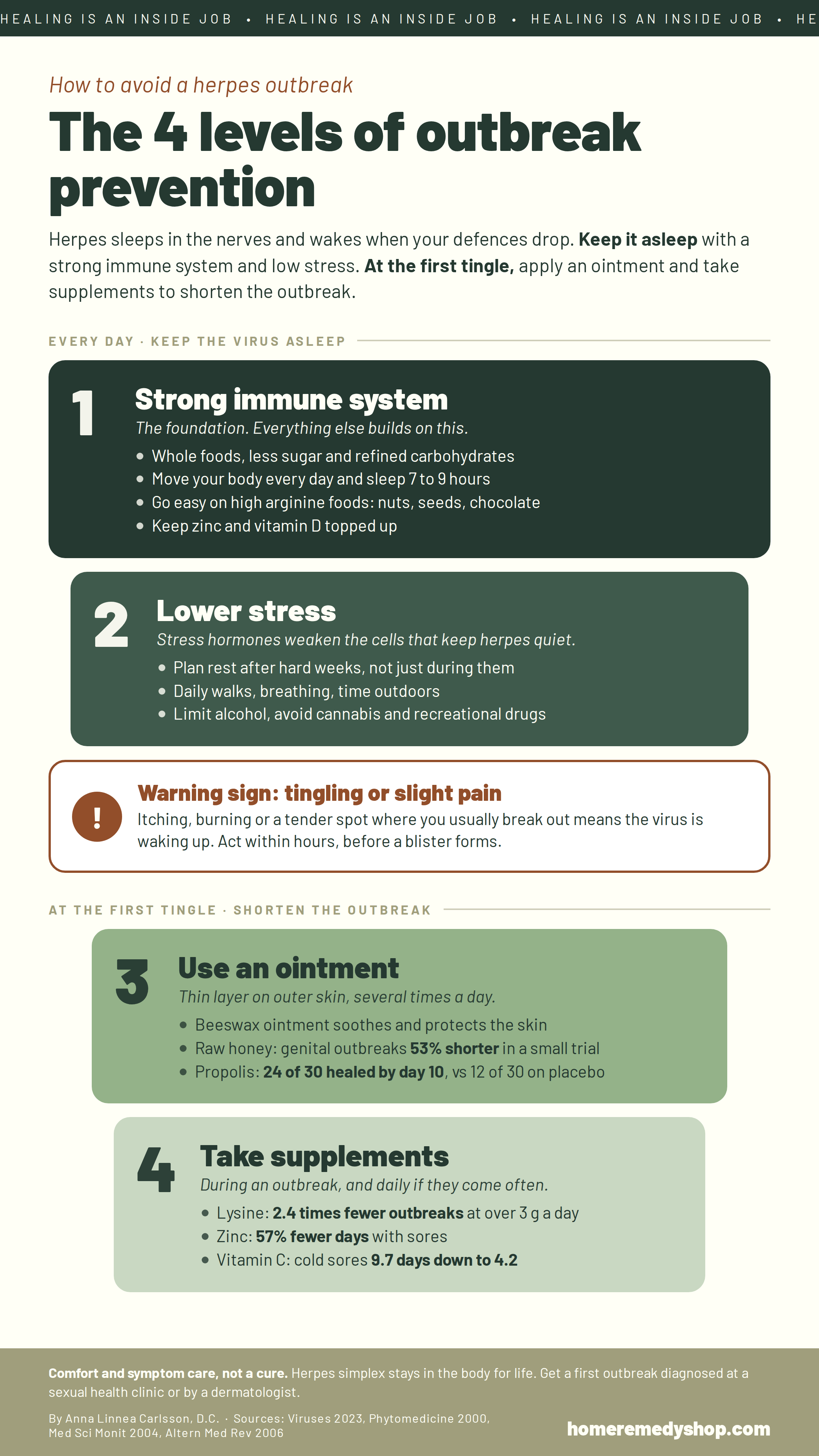
There’s research behind this. In one trial, honey applied to herpes sores made lip outbreaks 35% shorter and genital outbreaks about half as long compared with a standard cream. In another, 24 of 30 people using a propolis ointment had healed by day 10 of a genital outbreak. You can find more options in our guide to natural herpes remedies.
How to Shorten a Herpes Outbreak With an Ointment
The ointment is where you can make the biggest difference to how long an outbreak lasts, but only if you use it at the right moment.
Start at the first tingle
Don’t wait for blisters. The moment you feel tingling, itching or burning, put the ointment on. That’s when the virus is on its way to the skin, and when you can still stop it from building up. I put a beeswax ointment on as soon as I feel it coming, and in my experience the outbreak is usually gone within about two days. It doesn’t sting. The beeswax smooths the skin, and the relief is quick.
How to use it
- Wash your hands and gently clean the area with water. Pat dry.
- Apply a thin layer with a clean fingertip or a cotton bud.
- Reapply four or five times a day, and before bed.
- Wash your hands again straight after, so you don’t spread the virus to your eyes or other skin.
- Keep going until the skin has fully healed, not just until the pain stops.
Why beeswax helps
Beeswax forms a soft, protective layer over the skin. A 2025 study found that beeswax extract is strongly anti inflammatory and antibacterial, which helps explain why sores settle quickly under it and are less likely to get infected. Reviews of bee products, including honey, propolis and beeswax, describe real antiviral activity against viruses such as herpes. Beeswax hasn’t been tested on herpes outbreaks in people, so I share it as my own experience, backed by what we know about bee products.
The ointment I use at the first tingle
The Aromafisis beeswax ointment with oregano is handmade from olive oil, beeswax, oregano oil, clary sage and mastic oil, with no preservatives. I use it on every outbreak, and it’s usually gone within about two days.
Not an affiliate link. I recommend it because I use it myself. It’s comfort care for the skin, not a cure for herpes.
Help the ointment do its job
- Don’t touch, pick or pop the blisters. It spreads the virus and can let bacteria in, which makes the outbreak last longer.
- Keep genital skin dry and cool. Wear loose cotton underwear and avoid tight trousers.
- Protect your lips from sun and wind once the sore has healed.
- Rest. Go to bed earlier for a few nights. If pain keeps you awake, see our tips on how to sleep during a herpes outbreak.
Build Your Immunity With a Balanced Diet
The ointment helps the outbreak you have now. Your diet decides how well your body handles the next one. A strong immune system needs building blocks, and most of them come from your plate. I focus on three things: protein, fruit and vegetables.
Protein: the building blocks of your immune cells
Your immune cells and antibodies are made from protein. A review on nutrition and immunity explains that a lack of protein impairs immune function and makes people more vulnerable to infections, because amino acids are needed to activate the cells that fight viruses. Aim for a portion of protein at every meal, about the size of your palm:
- Eggs
- Fish, such as salmon, sardines and mackerel
- Chicken and turkey
- Plain yogurt, kefir and cheese
- Lentils, chickpeas and beans
- Tofu and tempeh
Many of these foods are also rich in lysine, an amino acid often recommended for herpes. A review of the research found that people taking more than 3 grams of lysine a day had 2.4 times fewer outbreaks, though lower doses didn’t work as well. Some people also cut back on foods high in arginine, such as nuts, seeds and chocolate, during an outbreak.
Fruit and vegetables: five portions a day
Fruit and vegetables give your immune system vitamins, minerals and antioxidants it can’t work without. In a trial, older adults who ate five portions of fruit and vegetables a day had a stronger immune response than those who ate two portions. Five portions is an easy goal to remember. Good choices include:
- Vitamin C: peppers, kiwi, oranges, strawberries, broccoli
- Vitamin A and antioxidants: carrots, sweet potato, spinach, kale
- Zinc and folate: leafy greens, pumpkin, legumes
- Colour: berries, beetroot, red cabbage and tomatoes
Zinc also matters for herpes specifically. A zinc treatment was found to shorten cold sores from 9.7 to 4.2 days on average.
A simple balanced plate
- Half the plate: vegetables, raw or cooked
- A quarter: protein
- A quarter: whole grains or potatoes
- Plus: a piece of fruit, some olive oil and plenty of water
What to cut back on
Sugar, alcohol and highly processed food ask a lot from your body and give very little back. When I notice outbreaks coming more often, these are the first things I look at. Keeping them low, especially during stressful weeks, gives your immune system room to do its job.
More than food
Diet works best together with sleep, movement and lower stress. Seven to nine hours of sleep, a daily walk and time to rest after a hard week all help keep the virus asleep. We go deeper into this in how to avoid a herpes outbreak.
How Long Is Herpes Contagious?
A herpes outbreak is contagious from the first tingle until the skin has completely healed and the crust has fallen off. The most contagious time is when the blisters are open. The virus can also reach the skin without any symptoms, so herpes can sometimes pass on even when you can’t see anything. A large study found that people with genital herpes had virus on their skin on about 1 in 5 days, often with no sore at all. Avoid kissing, oral sex and sex during an outbreak, and don’t share towels, lip balm or cups.
Can a Herpes Outbreak Last for Months?
Not normally. A repeat outbreak that’s still there after two to three weeks isn’t typical. It can mean the sore has become infected, that something else is going on, or that the immune system needs support. It’s a reason to see a doctor, not to keep waiting.
When to See a Doctor
- An outbreak that hasn’t healed after three weeks, or sores that keep getting bigger. See your GP or a dermatologist.
- A possible first outbreak. Visit a sexual health clinic or your GP while the sores are fresh, so they can take a swab and confirm it.
- Signs of infection: spreading redness, yellow pus, warmth or fever. See your GP.
- Very frequent outbreaks, six or more a year. Ask your GP to check your general health, including iron, vitamin D and B12.
- A weakened immune system, from illness or medication. Tell your doctor about every outbreak.
- A painful red eye or blurred vision. See an eye doctor the same day.
- Pregnancy. Tell your midwife or obstetrician if you have herpes or an outbreak.
Knowing exactly what you’re dealing with is what lets you care for it the right way naturally. For a full overview of natural care, read our guides to genital herpes outbreak treatment at home and herpes on lips.
Frequently Asked Questions
How long does a herpes outbreak last?
A repeat outbreak usually lasts about 7 to 10 days, from the first tingle until the skin has healed. A first outbreak usually lasts two to three weeks.
How long does the first herpes outbreak last?
Usually about two to three weeks, with an average of around 19 days for a first genital outbreak. It’s often the heaviest one, with flu like symptoms and swollen glands.
Why is my herpes outbreak lasting so long?
Long outbreaks usually mean your immune system is under pressure, for example from stress, illness, poor sleep or a diet low in protein and fresh food. A sore that gets infected also takes longer to heal. If an outbreak hasn’t healed after three weeks, see a doctor.
How can I make a herpes outbreak go away faster?
Start an ointment such as beeswax, honey or propolis at the very first tingle, keep the area clean and dry, don’t touch the sores and get extra rest. Eating enough protein, fruit and vegetables supports your immune system in clearing the virus.
How long can a herpes outbreak last without medication?
Without any treatment, a repeat outbreak usually heals on its own in about 7 to 10 days, and a first outbreak in about two to three weeks.
How long is a herpes outbreak contagious?
From the first tingle until the skin has completely healed. It’s most contagious while the blisters are open.
This article is for general information and does not replace a diagnosis. If an outbreak doesn’t heal, keeps coming back or you feel unwell, see your GP, a dermatologist or a sexual health clinic.
