
Foot Tendonitis: Causes, Therapy and Exercises to Heal It Naturally

Written by Montoya Sigafoose, founder of Home Remedy Shop · Medically reviewed by Veronique Claes d’Erckenteel, D.C., chiropractor since 1991 · Last reviewed: 27 October 2026
In all honesty, a chiropractor is your best option when it comes to foot tendonitis. Yes, tendonitis happens because of overstimulation of a certain tendon, but that overstimulation usually also affects the structure of your body: your ankle, knees, hips, pelvis and spine shift to protect the painful spot, and the way you load your foot changes. Putting everything back in balance is the key. If a certain activity triggers it, like running, dancing or a long day on your feet, check with a sports physio how you can change your movement for a better bodily experience. At home, calm the tendon with rest, ice and elevation, and then rebuild it with gentle foot tendonitis exercises. See a doctor straight away if you felt a pop or can’t stand on your toes.
Foot tendonitis is pain and irritation in one of the tendons that connect the muscles of your lower leg to the bones of your foot. It usually builds up slowly: a sore, stiff spot that hurts when you start moving, eases as you warm up, and comes back after activity. In this guide you’ll find what causes foot tendonitis, the different types (including tendonitis on the top of the foot), why chiropractic care and a sports physio make such a difference, the best exercises, and natural relief at home. For more foot care, see our guide to home remedies for calluses, or browse all our natural home remedies.
The short version
- Chiropractor: put your whole body back in balance.
- Sports physio: change the movement that triggers it.
- First days: protect, rest, ice, compression, elevation.
- Then: gentle exercises that rebuild the tendon step by step.
- Relief: cooling rub, massage, Epsom salt, anti-inflammatory foods.
- Prevent: build up activity slowly, good shoes, strong calves.
Get medical help the same day if you felt or heard a pop or snap at the back of the heel, feel like you were kicked there, can’t stand on your toes or walk normally (possible tendon rupture), or if the foot is red, hot and swollen with a fever. See a doctor if the pain doesn’t improve after 2 to 3 weeks of rest, if it started after taking certain antibiotics, if you have diabetes or rheumatoid arthritis, or if there’s numbness or tingling. Don’t keep running or training through tendon pain.
Table of Contents
- What Is Foot Tendonitis?
- What Causes Foot Tendonitis?
- Types of Foot Tendonitis
- Therapy for Foot Tendonitis: Why a Chiropractor Is Your Best Option
- Change Your Movement: See a Sports Physio
- How to Cure Foot Tendonitis: The First Steps at Home
- Foot Tendonitis Exercises
- Natural Relief for Foot Tendonitis
- How to Prevent Foot Tendonitis
- Frequently Asked Questions
What Is Foot Tendonitis?
Tendons are strong, rope-like bands of connective tissue that link your muscles to your bones. They’re tough, but they don’t like sudden changes in load. When a tendon works too hard, too long or in an unnatural way, tiny tears form, the tendon becomes irritated and painful, and over time it can thicken. Tendonitis, tendinosis and tendinopathy are all words for this condition (Pfefer et al., 2009).
Typical symptoms:
- Pain along the tendon that’s worse when you start moving, after rest or the morning after activity.
- Stiffness that eases as you warm up.
- Swelling or thickening along the tendon, sometimes warmth.
- Pain when pressing on the tendon, or a creaking feeling when it moves.
What Causes Foot Tendonitis?
- Overuse: doing more, faster or for longer than your tendons are used to: a new running plan, hiking holiday, dance classes or a job on your feet.
- Your body’s structure and alignment: flat feet, high arches, a stiff ankle, tight calves, a tilted pelvis or a difference in how you load your left and right side all change the load on the tendons.
- Footwear: worn-out shoes, shoes without support, high heels, or laces tied too tightly over the top of the foot.
- Injury: a twisted ankle or a direct blow.
- Medical conditions and medicines: diabetes, rheumatoid arthritis, gout, high cholesterol and some antibiotics increase the risk.
- Age and weight: tendons become less elastic with age, and extra weight adds load with every step.
A review of risk factors for Achilles tendinopathy named weak calf muscles, alcohol and certain antibiotics among the risk factors you can change (van der Vlist et al., 2019).
Types of Foot Tendonitis
Achilles Tendonitis
Pain at the back of the heel or a few centimetres above it, in the thick tendon that connects your calf to your heel. Common in runners, people who suddenly increase their walking, and people with tight calves.
Posterior Tibial Tendonitis
Pain along the inside of the ankle and arch. This tendon supports your arch, so if it’s overloaded, the arch can slowly flatten. Supportive insoles help (Gómez-Jurado et al., 2021).
Peroneal Tendonitis
Pain along the outside of the ankle and foot, often after ankle sprains or in people with high arches.
Top of the Foot Tendonitis
Top of the foot tendonitis (extensor tendonitis) affects the tendons that run over the top of your foot and lift your toes. It causes pain on the top of the foot that’s worse when you walk, run or pull your toes up. The most common causes are shoes or laces that are too tight, running uphill and tight calves. Loosen or re-lace your shoes (skip the eyelets over the sore spot), wear a pad under the tongue, and stretch your calves.
Flexor Tendonitis
Pain under the foot or along the inside of the ankle, in the tendons that curl your toes, common in dancers and people who push off a lot from their toes.
Therapy for Foot Tendonitis: Why a Chiropractor Is Your Best Option
In all honesty, a chiropractor is your best option when it comes to tendonitis. Yes, tendonitis happens because of overstimulation of a certain tendon, but usually that overstimulation also affects the structure of your body. When a tendon hurts, you start to walk differently without noticing: you shift your weight, turn your foot, lock your knee or tilt your hip. The rest of your body adapts around the pain, and those changes in turn keep loading the tendon the wrong way. Putting everything back in balance is the key.
A chiropractor looks at your whole body, not just the sore spot:
- Alignment: the joints of the foot and ankle, knees, hips, pelvis and spine, so your weight is carried evenly again.
- Mobility: freeing stiff joints, like a stiff ankle or big toe, that force the tendon to work harder.
- Soft tissue: massage and friction techniques on tight calves and the area around the tendon.
- Exercises and advice: a home programme, taping or bracing, footwear and insoles.
Chiropractors commonly use a whole range of conservative treatments for tendinopathy, including manipulation and mobilisation, exercise, friction massage, bracing, orthotics, ice and laser therapy (Pfefer et al., 2009). Our medical reviewer, Veronique Claes d’Erckenteel, has worked as a chiropractor since 1991.
Change Your Movement: See a Sports Physio
If you do a certain activity that triggers your tendonitis, you should check with a sports physio how you can change your movement for a better bodily experience. A sports physiotherapist can watch you run, walk, jump or dance, and find the movement habit that keeps overloading the tendon:
- Your running technique: stride length, cadence, how your foot lands.
- Your training: how quickly you increased distance, speed or hills.
- Your strength: weak calves, hips or core that let the foot do too much work.
- Your equipment: shoes, insoles, the surface you train on.
Small changes make a big difference: in runners with knee pain, gait retraining (for example a slightly quicker step rate and a softer landing) reduced pain (Petri et al., 2026). Chiropractic care for your structure and a sports physio for your movement work beautifully together.
How to Cure Foot Tendonitis: The First Steps at Home
Most foot tendonitis heals well within a few weeks to a few months, if you give it the right load: not too much, not too little. In the first painful days, use PRICE:
- Protect: supportive shoes, and avoid the activity that triggered it.
- Rest: relative rest, not bed rest: swap running for swimming or cycling if they’re pain-free.
- Ice: a cold pack wrapped in a towel for 15 minutes, a few times a day, for pain.
- Compression: a light elastic bandage or compression sock for swelling.
- Elevation: your foot above heart level when you sit or lie down.
After a few days, when the worst pain has settled, start the exercises below. Tendons heal by being loaded gradually, not by resting completely.
Foot Tendonitis Exercises
Start with exercises 1 to 3, and add the others as the pain allows. A pain level of 3 out of 10 during exercise is fine, as long as it settles by the next morning.
1. Ankle alphabet
Gentle movement keeps the ankle mobile without loading the tendon, and it’s safe even in the first painful days.
- Sit with your leg straight and draw the alphabet in the air with your big toe.
- Once or twice a day, each foot.
2. Calf stretch
Tight calves pull on the Achilles tendon and change how you load your whole foot.
- Hands on a wall, sore leg behind, heel down, knee straight: lean forward and hold 30 seconds.
- Then bend the back knee slightly and hold 30 seconds more.
- 3 times, twice a day; it should feel like a stretch, not pain.
3. Towel scrunches
Strengthens the small muscles under the foot that support the arch and the tendons around it.
- Sit with a towel on the floor and scrunch it towards you with your toes, then push it away.
- 2 minutes, once a day.
4. Resistance band ankle turns
Strengthens the tendons along the inside (posterior tibial) and outside (peroneal) of the ankle.
- Sit with a resistance band around your forefoot, anchored to the side.
- Turn the foot slowly inwards against the band, 15 times; then anchor it the other way and turn outwards, 15 times.
- 3 sets, every other day.
What the research says: Exercise programmes improved pain and function in people with posterior tibial tendon problems (Ross et al., 2018).
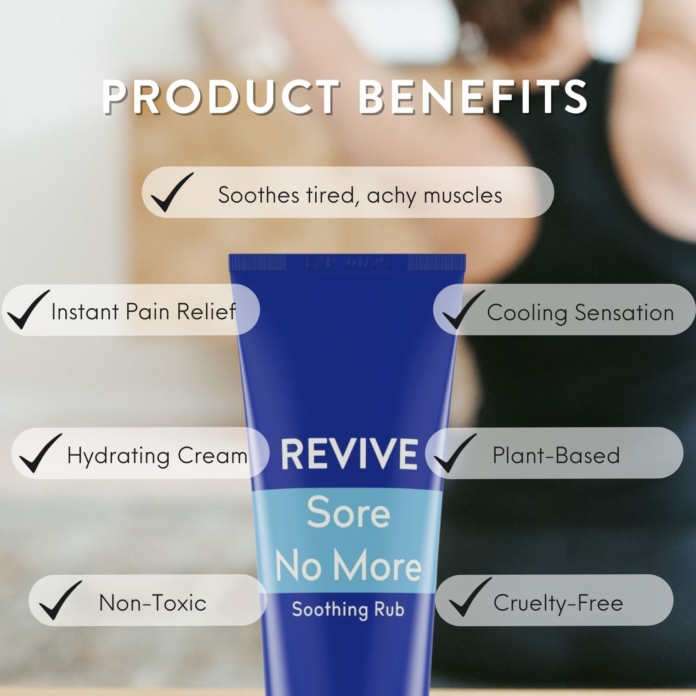
Cooling relief for sore tendons
A cooling rub after your exercises
After your exercises or a long day on your feet, a cooling cream massaged gently around the sore tendon and into the calf feels wonderful. Revive’s Sore No More rub combines menthol with peppermint and wintergreen oils for a fresh, cooling sensation on aching muscles and tendons.
- Plant-based, with menthol, peppermint and wintergreen
- Massage in gently, up to 4 times a day
- Adults and children 12 and older
- Not on broken skin or with a heating pad; skip it if you’re allergic to aspirin or take blood thinners
Affiliate link: we may earn a small commission at no extra cost to you.
5. Toe and foot lifts
For tendonitis on the top of the foot, gently strengthen the tendons that lift your toes and foot.
- Sit with your heels on the floor and lift your toes and the front of your feet up, then lower slowly.
- 15 times, 2 sets; add a light band over the top of the foot when it no longer hurts.
6. Double-leg heel raises
Builds calf and tendon strength before you move on to harder exercises.
- Stand holding a counter, rise slowly onto your toes on both feet and lower down in 3 seconds.
- 3 sets of 15, every other day.
7. Eccentric heel drops
The best-studied exercise for Achilles tendonitis: you slowly lower your body weight on the sore leg, which helps the tendon remodel and become stronger.
- Stand on the edge of a step on the balls of your feet.
- Rise up using both legs, then lift the healthy foot and lower slowly on the sore leg, counting to 3, until the heel is below the step.
- Do 3 sets of 15, once or twice a day, with the knee straight and again with the knee slightly bent.
- Mild discomfort is OK; sharp pain means stop and scale back.
What the research says: Eccentric exercise reduced pain and improved function in Achilles tendinopathy in a recent meta-analysis (Yuan et al., 2026).
8. Single-leg balance
Trains the ankle and foot to work together again, which protects the tendons.
- Stand on one leg for 30 seconds, holding on lightly at first.
- Make it harder by closing your eyes or standing on a cushion.
Natural Relief for Foot Tendonitis
- Massage: gently massage the calf and the muscles around the tendon, not hard on the tendon itself, with a cooling cream or a little oil.
- Epsom salt foot bath: half a cup in a lukewarm foot bath for 15 minutes in the evening, once the first swelling has gone down.
- Cabbage leaf wrap: chilled, lightly crushed cabbage leaves wrapped around the sore area for 20 to 30 minutes, a traditional cooling wrap for swelling.
- Warming cayenne rub: for stiff, chronic tendon pain (not new, hot or swollen), a pinch of cayenne in a tablespoon of coconut oil, massaged around the area; wash your hands well and keep it away from broken skin.
- Anti-inflammatory foods: oily fish or flaxseed for omega-3, turmeric with black pepper, ginger, berries and leafy greens; less sugar, alcohol and processed food.
- Acupuncture: some people find it helps with pain alongside exercise.
- Supportive shoes and insoles: cushioned heels, arch support and a slight heel rise take strain off the Achilles and posterior tibial tendons.
Heel pain under the foot? That’s more likely plantar fasciitis. For general aching feet, see sore feet, and for swelling, swollen feet.
How to Prevent Foot Tendonitis
- Build up slowly: increase distance, speed or training time by no more than about 10% a week.
- Warm up before sport, and stretch your calves afterwards.
- Strength train your calves, feet and hips a few times a week.
- Match your shoes to your activity, and replace running shoes every 500 to 800 km.
- Practise proper technique, and have your movement checked if the same pain keeps coming back.
- Keep your body in balance with regular chiropractic check-ups, especially if you’re very active.
- Listen to early warning signs: morning stiffness in a tendon means it’s time to scale back for a few days.
Frequently Asked Questions
What is the best therapy for foot tendonitis?
A chiropractor to put your whole body back in balance, combined with a progressive exercise programme. If a certain activity triggers it, a sports physio can help you change your movement.
How do you cure foot tendonitis?
Calm it with protection, relative rest, ice, compression and elevation, then rebuild the tendon with gradual exercises, and correct the alignment and movement habits that caused the overload. Most cases heal within weeks to a few months.
What causes tendonitis on the top of the foot?
Usually shoes or laces that are too tight, running uphill, or tight calves. Loosen your laces, pad the tongue of the shoe and stretch your calves.
What are the best foot tendonitis exercises?
Ankle alphabet, calf stretches, towel scrunches, resistance band ankle turns, toe lifts, heel raises, eccentric heel drops for the Achilles, and single-leg balance.
Can a chiropractor help foot tendonitis?
Yes. Tendonitis often goes together with changes in how your body is aligned and how you move. A chiropractor works on the whole body to restore balance, and uses soft tissue techniques, exercises, bracing and orthotics.
How long does foot tendonitis take to heal?
Mild cases often settle in 2 to 6 weeks; long-standing tendonitis can take 3 to 6 months of consistent exercise.
Should I walk with foot tendonitis?
Short, comfortable walks in supportive shoes are fine if the pain stays mild. Avoid long walks, hills and running until the tendon settles.
Is ice or heat better for foot tendonitis?
Ice in the first painful, swollen days; gentle warmth and massage for stiff, longer-lasting tendon pain.
When should I see a doctor for foot tendonitis?
Immediately if you felt a pop or can’t stand on your toes; otherwise if it doesn’t improve after 2 to 3 weeks, or if you have diabetes or rheumatoid arthritis.
Recommended
- Plantar Fasciitis Relief
- Home Remedies for Sore Feet
- Home Remedies for Calluses
- More natural home remedies
Some links on this page are affiliate links, marked as such. If you buy through them, we may earn a small commission at no extra cost to you. This article is for general information and does not replace a diagnosis from a qualified professional. Read our medical disclaimer or browse more natural remedies.

Comments are closed.