
Herpes Treatment at Home: Natural Remedies for Herpes That Actually Help

Herpes treatment at home comes down to two things: calming an outbreak quickly when it comes, and keeping the virus quiet so it comes back less often. Natural remedies can do a lot here. Beeswax and propolis ointments, raw honey, lemon balm, zinc and lysine all have research behind them, and in my own experience a beeswax ointment at the first tingle clears an outbreak in about two days. What no remedy can do yet, natural or medical, is remove the virus from your body. That’s why real herpes treatment isn’t something you only do during an outbreak. It’s how you live between them.
This guide is the starting point for everything we’ve written about herpes. It covers whether herpes can go away, where modern medicine stands on a cure, the natural remedies that work, and what to eat, avoid and change. From here you can go deeper into every specific topic.
The short version
- At the first tingle, apply a beeswax or propolis ointment, raw honey or a lemon balm cream to the skin several times a day.
- Take lysine, eat lysine rich foods, and cut back on sugar and high arginine foods like nuts and chocolate.
- Keep the area clean, dry and uncovered by tight clothing, and don’t touch or pop the sores.
- Between outbreaks, work on stress, sleep, movement and food. That’s what keeps the virus asleep.
- If it’s your first outbreak, get it confirmed first, so you know you’re treating the right thing.
What Is Herpes? HSV-1 and HSV-2 Explained
Herpes is an infection with the herpes simplex virus. There are two types, and both are extremely common. According to the World Health Organization, around two thirds of people under 50 carry HSV-1, and roughly one in eight people aged 15 to 49 carry HSV-2.
- HSV-1 is the herpes 1 virus most people know as cold sores or fever blisters. It mostly causes herpes on the lips, but it’s now also a common cause of genital herpes, spread through oral sex.
- HSV-2 mostly causes genital herpes. Its symptoms are the same kind of tingling, blisters and sores, just in the genital area. Our guide to genital herpes outbreak treatment at home covers that side in full.
Both types can also show up in other places, such as the chin, nose, cheek or tongue. See herpes outbreaks on the face and the tongue. The treatment approach on this page works for both types, wherever they appear.
If you’ve never had a diagnosis, get one before you start treating. A sore on the lip or genitals can be something else entirely, like a canker sore, an ingrown hair or a fungal infection. A sexual health clinic (for genital sores) or a dermatologist (for the face and lips) can swab a fresh blister and tell you for sure. Knowing exactly what you’re dealing with is what makes natural treatment work.
Can Herpes Go Away?
Yes and no, and understanding the difference changes everything about how you treat it.
An outbreak always goes away. Even without any treatment, sores heal on their own, usually within one to three weeks. For the typical timeline, see how long a herpes outbreak lasts.
The virus does not go away. After the first infection, herpes travels along a nerve and settles in a nerve cluster, near the jaw for oral herpes and near the base of the spine for genital herpes. There it sleeps. A 2023 review of natural treatments describes this as a latent infection that usually stays for life, and every repeat outbreak is that same sleeping virus waking up.
That sounds discouraging, but here’s the part that matters: how often it wakes up is something you can influence.
Viral load: what you can actually change
Think of the virus in two amounts. The first is the virus sleeping in the nerve. Nothing available today reaches it. The second is your viral load at the skin: how often the virus wakes up and how much of it reaches the surface. That is what decides how many outbreaks you get, how bad they are, and how easily you pass it on.
The virus can even wake up quietly. A study that swabbed 498 people with genital herpes every day found virus on the skin on about 1 in 5 days, often with no sore at all, and doctors found oral herpes virus in the mouths of healthy people with no symptoms as far back as 1953.
So when people ask how to get rid of herpes naturally, this is the honest answer. You can’t get rid of the virus, but you can keep it so quiet that it rarely bothers you. A calmer virus means fewer outbreaks, shorter ones, less pain and less risk to partners.
Not included above because the page says there isn’t real evidence for them on herpes: olive oil, echinacea, baking soda, tea bags, cornstarch, Epsom salts, black coffee, and goldenseal. The page also says to skip toothpaste, hydrogen peroxide, and alcohol on sores entirely, since they damage healing skin rather than help it.
Is There a Cure for Herpes? Where Modern Medicine Stands
Not yet, but modern medicine is closer than it has ever been, and the progress is real.
The most talked about work comes from the Fred Hutchinson Cancer Center in Seattle, where Dr. Keith Jerome’s team is developing a gene editing therapy. Instead of calming the virus like every treatment so far, it aims to destroy the sleeping virus itself. In their 2024 study in Nature Communications, the therapy removed about 90% of the sleeping HSV-1 after oral infection and up to 97% after genital infection in mice, and the treated mice shed far less virus afterwards. Fred Hutch itself calls the results encouraging, but is clear that this is not yet a cure and human trials haven’t started. The team is working with regulators and partners on the safety steps needed first, and as of September 2026 there is no human trial or cure announcement on their herpes research news page.
Gene editing has also been tried in people, for one specific form of herpes. In China, a small study of three patients with a severe herpes infection of the eye reported no return of the infection over about 18 months after gene editing treatment, and a larger trial of that therapy is now running. It’s promising, but it’s for the eye only, not for cold sores or genital herpes.
So if you’re searching for the latest herpes cure update, the honest summary for 2026 is this: a cure is being worked on seriously, it has worked in mice and in a handful of eye patients, and it is not available to anyone with cold sores or genital herpes yet. Until it is, the way you live with the virus is still the most powerful treatment you have. And every step you take now to keep your viral load low will only make any future treatment’s job easier.
Herpes Treatment Starts Between Outbreaks
This is the core of how we approach herpes, and it’s the part most remedy lists leave out. There is no home remedy that will solve herpes if you only take care of your health on the days an outbreak hurts. Health is a continuous effort. Keeping your viral load low means helping your immune system battle this virus every single day, through movement, food and your environment.
- Movement. Regular movement you enjoy keeps your body strong and your stress in balance. Walking, swimming, yoga. It doesn’t need to be intense, it needs to be consistent.
- Food. Whole foods, enough protein, and less sugar and refined carbohydrates, which the 2023 review links to flare ups. More on food below.
- Sleep. Your body controls herpes through a coordinated balance of fast and long term immune defences, and that balance depends on rest.
- Environment. The people, places and pace you surround yourself with. Which brings us to stress.
Can Stress Cause a Herpes Outbreak?
Yes. A landmark study showed that psychological stress can directly reactivate sleeping herpes virus, and an analysis pooling several studies confirmed that stress predicts outbreaks. Stress hormones weaken the very immune cells that keep herpes in check, which is why outbreaks so often follow a hard week.
If herpes keeps coming back for you, season after season, the first step isn’t a remedy. It’s self-awareness and self-connection. Most people who get frequent outbreaks have a stress pattern they keep repeating, or keep letting happen in their environment: the same overcommitment, the same conflict, the same season they dread. Without facing that pattern and becoming fully aware of it, stress keeps peaking in the same places, and every peak leaves the door open for the virus. Start by looking back at your last few outbreaks and what was happening the week before each one. If the pattern feels bigger than you can untangle alone, a psychologist or therapist who works with stress can help you see it clearly.
Other common triggers are illness and fever, sun on the lips, friction, menstruation and tiredness. We cover all of them in how to avoid a herpes outbreak.
How to Stop a Herpes Outbreak in Its Tracks
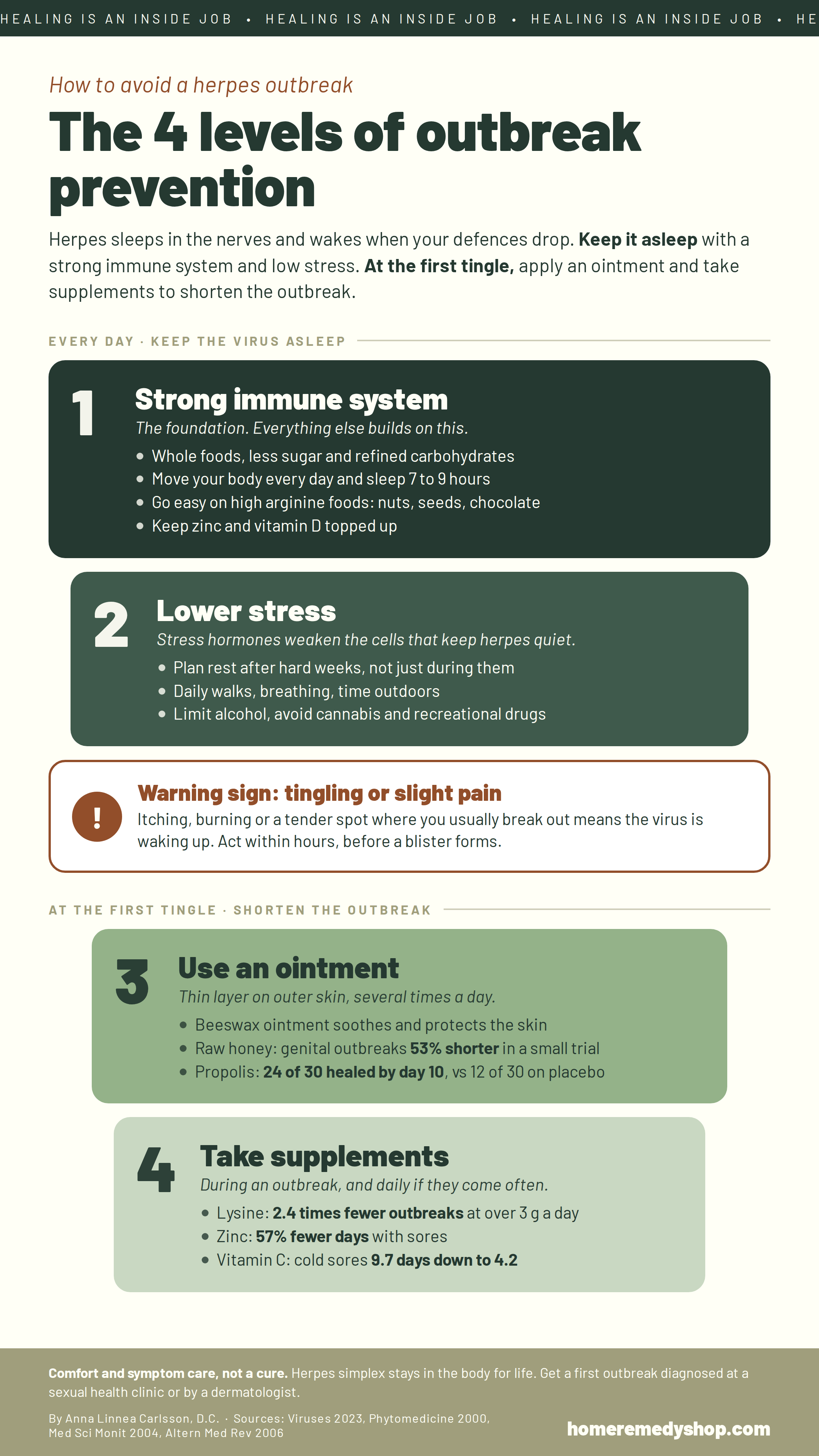
Timing is everything. Most outbreaks start with a warning: tingling, itching, burning or a tender spot where you usually break out, a day or so before any blister appears. For every early sign, see herpes outbreak symptoms. That warning is your window. Start your remedy then, and an outbreak is often smaller and much shorter, sometimes stopping before a blister forms at all. Each phase after that is explained in herpes outbreak stages.
Natural Remedies for Herpes With Research Behind Them
These are the remedies that have been tested on the herpes virus, many of them on real outbreaks in people. Apply topical remedies at the first tingle, use a clean fingertip or cotton bud each time, and patch test first. For a head to head comparison of which works hardest, see our guide to the strongest natural antiviral for herpes.
1. Beeswax ointment
This is what I use myself on every outbreak. I apply a thin layer the moment I feel it coming, and in my experience it’s usually gone within about two days. It doesn’t sting. The beeswax smooths over the sore and protects it, which stops the cracking and rubbing that make outbreaks so painful. A 2025 study found beeswax extract to be strongly anti-inflammatory and antibacterial, and two reviews, from 2022 and from 2026, gather the evidence on bee products against viruses. Beeswax itself hasn’t been tested on herpes directly yet, so here my experience runs ahead of the research.
2. Propolis
Propolis, the resin bees make, is about 30% beeswax and is one of the best studied natural herpes treatments. In a trial of 90 people with genital herpes, 24 of 30 using propolis ointment had healed by day 10, compared with 12 of 30 on a placebo. On cold sores, a 3% propolis ointment brought healing time down to 6.2 days from 9.8. Skip it if you’re allergic to bee products.
3. Raw or manuka honey
In a small trial, people treated one outbreak with honey and another with a standard medical cream. Honey cut genital outbreaks by about half and lip outbreaks by a third, with less pain and no side effects. Only 16 people took part, so treat it as promising, not proven.
4. Lemon balm
Lemon balm cream eased cold sore symptoms within two days in a double blind trial, and lab research shows lemon balm extract blocks the genital herpes virus from multiplying. It belongs to the mint family, whose extracts, including sage, thyme and peppermint, cut herpes infection by more than 90% in the lab. Use a cream, or a strong cooled lemon balm tea on a cotton ball.
5. Zinc
In small studies, daily zinc cut the number of days with genital sores by 57%, and a zinc oxide cream shortened cold sores in a randomised trial. People with recurring cold sores also tend to have lower zinc levels.
6. Tea tree, oregano and other essential oils
Tea tree oil has antiviral activity against herpes in the lab and was tested as a 6% gel on cold sores. Thyme, ginger, chamomile and hyssop oils reduced genital herpes virus by more than 90% in the lab, and peppermint oil inactivated both herpes types on contact. These are lab results, and undiluted oils can burn sensitive skin, especially genital skin. How to choose and dilute them safely, including oregano oil, is in essential oils for cold sores.
7. Licorice root and aloe vera
Licorice root extract showed activity against HSV-1 in the lab, and so did aloe vera gel. Both are gentle, soothing options on the skin.
8. Ice
A cold compress wrapped in a cloth won’t touch the virus, but a few minutes at a time eases swelling, itching and pain while a remedy starts working.
Herbs and Supplements for Herpes
- Lysine. The most studied supplement for herpes. In a six month trial, people taking it had 2.4 times fewer outbreaks, with doses above 3 g a day working where under 1 g did not. An older trial agreed, though a later review calls the overall evidence mixed.
- Zinc. A steady daily habit rather than a last minute fix, as above.
- Vitamin C. With bioflavonoids, it shortened outbreaks from 9.7 to 4.2 days in a double blind trial.
- Vitamin D. Low vitamin D has been linked to higher rates of both herpes types.
- Lemon balm tea as a daily calming herb, which also helps with the stress side.
Check with a pharmacist before starting supplements if you’re pregnant, have kidney problems or take regular medication. Curious about homeopathy? We look at what the evidence really says in homeopathic remedies for cold sores.
Foods High in Lysine for Herpes, and Foods That Trigger Outbreaks
Herpes needs the amino acid arginine to multiply, and lysine works against it. The 2023 review suggests people prone to outbreaks favour lysine and go easy on high arginine foods, especially during stressful periods, and cut back on refined carbohydrates and sugar.
- Foods high in lysine: fish, chicken, eggs, yogurt, cheese and other dairy.
- Foods that can feed outbreaks: nuts, seeds, chocolate, and sweets and refined carbohydrates. You don’t have to cut nuts and seeds forever, since they’re healthy foods. Just ease off when you feel run down or an outbreak is coming.
- Also worth limiting: alcohol, and cannabis and recreational drugs, which the review found weaken the body’s defence against herpes.
Herpes Treatment at Home: Comfort Care During an Outbreak
- Keep sores clean and dry. Wash gently with plain water, pat dry, or use a hairdryer on a cool setting.
- Wear loose cotton clothing over genital outbreaks.
- Don’t touch, pick or pop the sores, and wash your hands after applying anything.
- For itching, a cool compress or a little aloe gel helps more than scratching ever will.
- If passing urine stings during a genital outbreak, pour lukewarm water over the area while you go.
- Avoid kissing and sexual contact from the first tingle until the skin has fully healed.
- Rest. If pain or itching keeps you awake, see how to sleep during a herpes outbreak.
- Prefer something from the pharmacy? We compared the options in cold sore remedies over the counter.
What Doesn’t Have Evidence
Many older home remedy lists, including an earlier version of this page, recommend olive oil, echinacea, baking soda, tea bags, cornstarch, Epsom salts, black coffee and goldenseal. We couldn’t find herpes specific research for any of them, so they’re no longer on this list. Some are harmless comfort measures. None of them treat the virus. And skip toothpaste, hydrogen peroxide and alcohol on sores: they damage the healing skin.
When to See a Doctor
- A first outbreak, or anything you’re unsure about. A sexual health clinic or dermatologist can confirm it with a swab.
- Pregnancy. Tell your midwife or obstetrician, especially near your due date.
- Babies. Never kiss a baby when you have a sore, and see a paediatrician straight away if a baby has sores around the mouth. Read cold sores in babies and newborns.
- Sores near or in the eye, or a red, painful eye. See an eye doctor the same day.
- A weakened immune system, outbreaks that spread, come very often, or haven’t healed within two weeks.
Every Herpes Guide on Home Remedy Shop
- Genital herpes outbreak treatment at home
- Home remedies for herpes on lips
- How to get rid of cold sores
- Fever blisters: causes, stages and natural remedies
- Herpes outbreak symptoms
- Herpes outbreak stages
- How long does a herpes outbreak last
- How to avoid a herpes outbreak
- The strongest natural antiviral for herpes
- Essential oils for cold sores
- Homeopathic remedies for cold sores
- Cold sore remedies over the counter
- Cold sore or canker sore
- Herpes outbreak on the face and the tongue
- How to sleep during a herpes outbreak
- Cold sores in babies and newborns
What I put on every outbreak
This handmade beeswax ointment with oregano, clary sage and mastic oil is what I reach for at the first tingle. In my experience it clears an outbreak in about two days, and it never stings. Nobody pays me to recommend it. I recommend it because it works for me.
Frequently Asked Questions
Can herpes go away?
Outbreaks always go away, usually within one to three weeks. The virus itself stays in your nerves for life, but with good daily care it can stay quiet so outbreaks become rare and mild.
Is there a cure for herpes?
Not yet. Gene editing research at Fred Hutch removed up to 97% of the sleeping virus in mice, and a similar therapy is being trialled in China for herpes of the eye, but no cure is available for cold sores or genital herpes as of 2026.
What is the best natural treatment for herpes?
The remedies with the strongest research are propolis, honey, lemon balm, zinc and lysine. My own first choice is a beeswax ointment at the first tingle, which usually clears an outbreak in about two days for me.
How do you stop a herpes outbreak in its tracks?
Act at the first tingle or itch, before a blister forms. Apply a beeswax or propolis ointment, honey or lemon balm several times a day, take lysine, and rest.
What can I put on herpes sores?
A beeswax or propolis ointment, raw or manuka honey, lemon balm cream, a zinc oxide cream, or well diluted essential oils. Avoid toothpaste, hydrogen peroxide and alcohol, which damage healing skin.
What foods should I eat if I have herpes?
Foods high in lysine, like fish, chicken, eggs, yogurt and cheese. Go easy on nuts, seeds, chocolate, sugar and alcohol, especially when you feel run down.
Can stress cause a herpes outbreak?
Yes. Research shows stress can directly reactivate the virus. If outbreaks keep coming back, look for the stress pattern behind them. Self-connection is the first step.
What is the difference between HSV-1 and HSV-2?
HSV-1 mostly causes cold sores and herpes on the lips, and HSV-2 mostly causes genital herpes. Both can appear in either place, and both respond to the same natural care.
How long does a herpes outbreak last?
Usually one to two weeks for a repeat outbreak and up to three weeks for a first one. Starting treatment at the first tingle can shorten it a lot.
This guide is for comfort and symptom care and does not replace a diagnosis. Herpes simplex stays in the body for life, and no remedy on this page removes it. Get a first outbreak confirmed by a sexual health clinic or dermatologist before treating it.
