
Dry Cough Remedies: How to Get Rid of a Dry Cough Fast

Written and medically reviewed by Veronique Claes d’Erckenteel, D.C., chiropractor since 1991 · Last reviewed: 16 October 2026
To get rid of a dry cough, soothe and moisten your throat as much as you can, because a dry cough isn’t clearing anything out: it’s an irritated, dried out throat reacting. Drink plenty of water and warm infusions, skip coffee and sodas, take honey and ginger tea, run a humidifier, and use two simple tricks: moving moisture from the back of your nose down your throat, and humming with your mouth closed instead of coughing. Most dry coughs settle within three weeks. One that keeps going is worth getting properly checked.
A dry cough feels completely different from a chesty one. There’s no mucus to bring up. Instead there’s an itch, a scratch, a dryness that makes every breath tickle, and sometimes you’re simply annoyed by how dry the air is. Coughing doesn’t bring relief, it just scrapes an already irritated throat and sets off the next cough.
That’s why dry cough remedies work differently. Many of the natural remedies stay the same, like ginger tea and honey infusions, but the goal changes. With a dry cough, you’re not helping your body push something out. You’re calming and smoothing the throat so the irritation can settle. This guide is part of our cough series; for every type of cough, start with how to stop coughing.
The short version
- Soothe, don’t cough: every cough irritates a dry throat further.
- Drink water and herbal infusions all day. Avoid coffee and sodas.
- Use the throat lubrication trick and hum with your mouth closed (both shown below).
- Honey, ginger tea, marshmallow root and licorice coat and calm the throat.
- Run a cool mist humidifier, especially at night.
- A dry cough that lasts longer than three weeks deserves a proper diagnosis.
Table of Contents
- What Causes a Dry Cough?
- Dry Cough and Throat: Why It Itches and Hurts
- How to Get Rid of a Dry Cough: Soothe, Don’t Cough
- The Throat Lubrication Trick
- Hum and Gargle With Your Mouth Closed
- What to Drink (and Avoid) With a Dry Cough
- Natural Dry Cough Remedies
- A Humidifier for Dry Cough
- Natural Dry Cough Drops
- Dry Cough at Night
- A Consistent Dry Cough: When to See a Doctor
- Frequently Asked Questions
What Causes a Dry Cough?
A cough is meant to clear mucus, dust and germs from your airways. A wet cough does exactly that. A dry cough, on the other hand, brings nothing up. It almost seems as if the cells lining the throat are agitated, rather than the body trying to push bacteria out. The nerve endings in an irritated throat are oversensitive, so even a breath of dry air or a laugh sets off the cough reflex.
A 2026 review in the Australian Journal of Pharmacy describes how an acute cough often starts dry and only later turns productive, and looks at nine natural ingredients used for both stages, including honey and ginger. The most common reasons for a dry cough are:
- The start or the tail end of a cold. The airway lining is inflamed, and it can stay sensitive for weeks after the infection has gone.
- Dry air. Heating, air conditioning and long flights dry out the throat and nose.
- Post nasal drip. Mucus running down the back of the throat tickles it constantly. See post nasal drip remedies.
- Acid reflux. Stomach acid reaching the throat, often after meals or when lying down. See GERD cough remedies.
- Allergies and irritants. Pollen, dust, smoke, perfume and cleaning products.
- Not drinking enough. A dehydrated body makes less of the thin fluid that keeps your throat moist.
Knowing the reason for your dry cough tells you what to treat. If you’re not sure, the section on when to see a doctor tells you who can find out.
Dry Cough and Throat: Why It Itches and Hurts
With a dry cough, the throat is where you feel everything. It can itch, as if there’s a feather at the back of your throat. It can feel parched, like sandpaper. And after a day of coughing, your throat hurts, because every cough rubs the inflamed lining a little more.
This is the loop that keeps a dry cough going: the throat is dry and irritated, so you cough; the cough irritates the throat further, so you cough again. Breaking that loop is the whole point of the remedies below. A dry cough with an itching throat responds best to anything that coats and moistens, and a sore throat calms down as soon as you cough less. For extra relief, see our tea for sore throat guide.
How to Get Rid of a Dry Cough: Soothe, Don’t Cough
Genuinely, what we want to do with a dry cough is smooth the throat as much as possible. Every step in this guide serves that one goal:
- Keep the throat moist from the inside: water, warm infusions and the throat lubrication trick.
- Replace the cough with something gentler: swallowing, and humming or gargling with your mouth closed.
- Coat and calm the lining: honey, ginger, marshmallow root, licorice and natural drops.
- Change the air: a humidifier, steam and no smoke.
- Treat the cause: post nasal drip, reflux or allergies, if one of those is behind it.
The second step matters more than most people think. Coughing doesn’t really help a dry cough. Speech therapists teach people with a lingering cough to answer the urge with a swallow and a slow breath instead, and in a placebo controlled trial this clearly reduced chronic coughing. The two tricks below are my own versions of that idea.
The Throat Lubrication Trick
This little trick takes some practice, but it really does the job. The goal is to keep your throat lubricated by taking the little fluid you already have and moving it to the right place. There’s always some moisture at the back of your nose (the nasopharynx). With a dry cough, it just doesn’t reach the parts of your throat that need it.
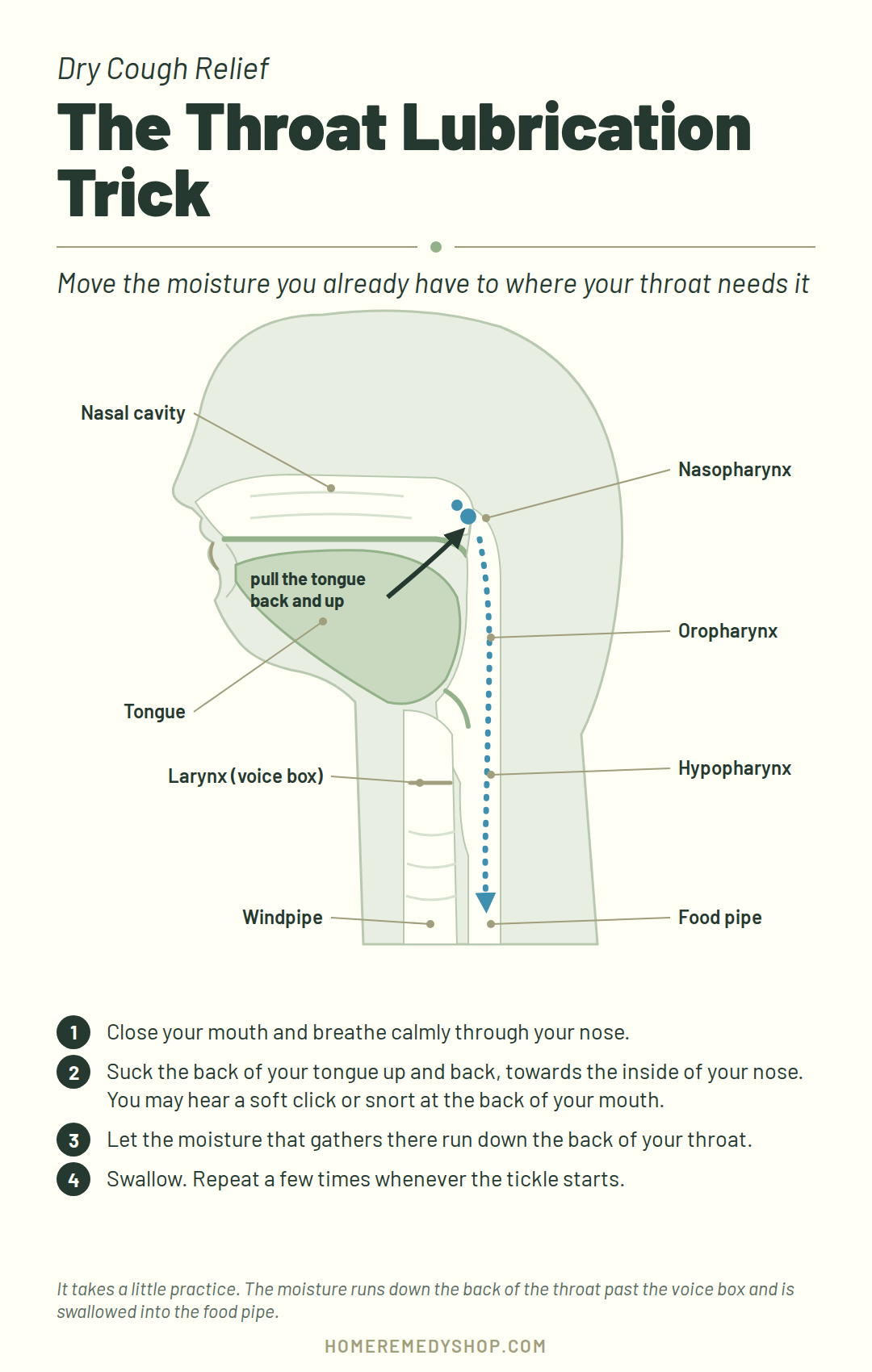
- Close your mouth and breathe calmly through your nose.
- Suck the back of your tongue up and back, towards the internal passage of your nose. You may make a soft, rousing click or snort at the back of your mouth. That’s normal.
- Let the moisture that gathers there run down the back of your throat, past the voice box.
- Swallow. Repeat a few times whenever you feel the tickle coming.
The first few times it may feel strange. After a day or two it becomes automatic, and you’ll notice you can stop many coughs before they start.
Hum and Gargle With Your Mouth Closed
When the urge to cough comes, it’s better to make gargling sounds with your mouth closed than to cough. It’s the practice of moving and vibrating the back of the throat (the oropharynx) and the area around the voice box (the hypopharynx). The vibration loosens and calms the throat without the scraping force of a cough.
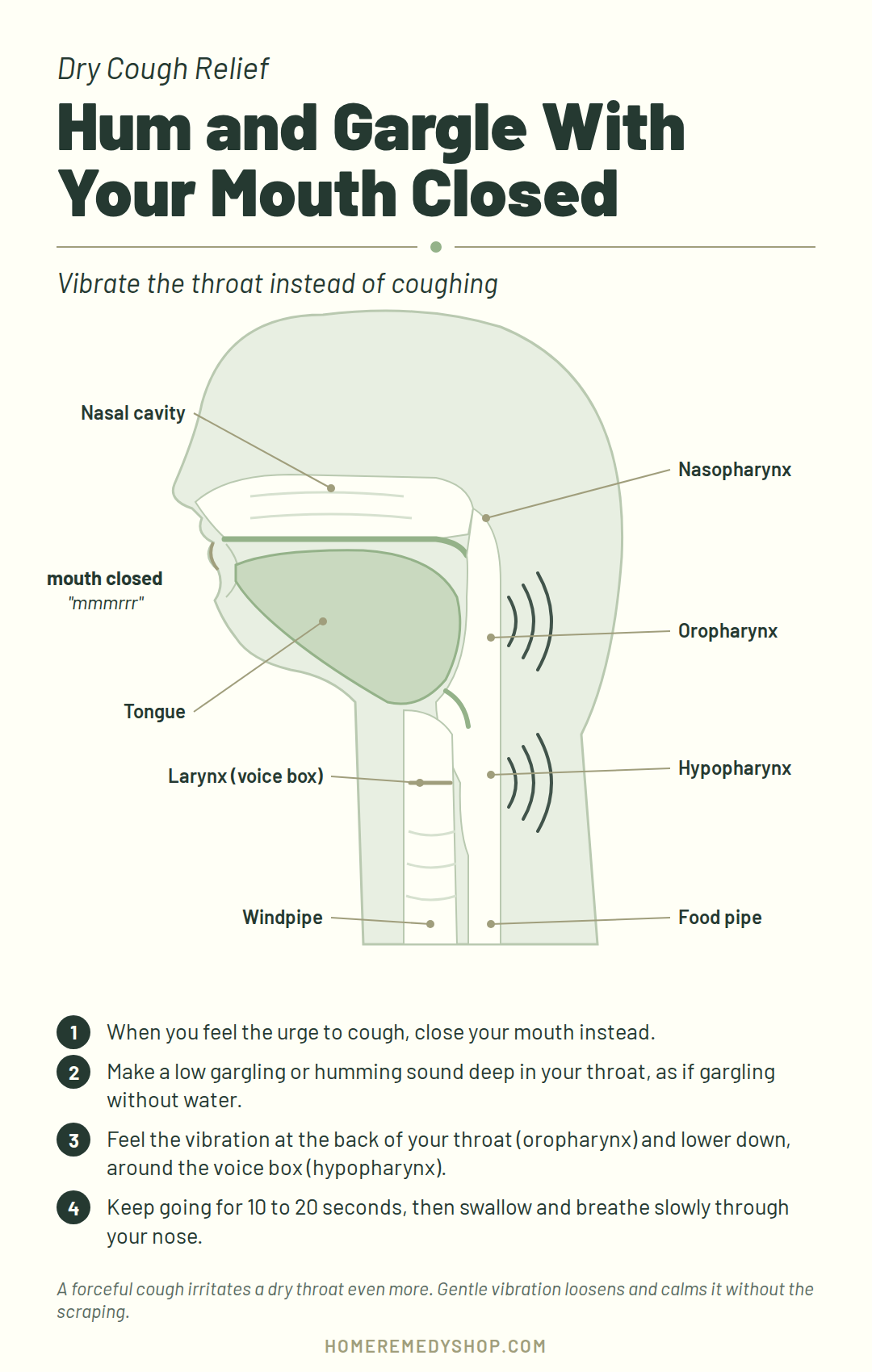
- When you feel the urge to cough, close your mouth.
- Make a low gargling or humming sound deep in your throat, as if you were gargling without water.
- Feel the vibration at the back of your throat and lower down, around the voice box.
- Keep it going for 10 to 20 seconds, then swallow and breathe slowly through your nose.
Combine both tricks: hum first, then pull the moisture down and swallow. It’s quiet enough to do at work or in bed next to a sleeping partner.
What to Drink (and Avoid) With a Dry Cough
The most important part of getting rid of a dry cough is what you drink. Your throat can only stay moist if your body has enough fluid to work with.
Drink plenty of:
- Water, little and often throughout the day.
- Warm herbal infusions: ginger, chamomile, marshmallow root, licorice, linden flower or thyme.
- Warm water with honey and lemon.
- Clear broths and soups.
Avoid as much as you can:
- Coffee and strong black tea. In my experience they leave the throat drier, and in larger amounts caffeine makes you pass more water.
- Sodas and fizzy drinks. The sugar and acid irritate an already raw throat, and they don’t replace water.
- Alcohol, which dries out the lining of the mouth and throat.
- Very cold drinks, which can trigger a coughing fit in a sensitive throat.
For tea recipes, see our guide to tea for cough.
Natural Dry Cough Remedies
These are the home remedies for dry cough I come back to. Some have been passed from generation to generation, some now have research behind them too. For the full list of cough remedies, see our guide to cough remedies at home.
Honey
Honey is the first remedy for a dry cough, because it coats the throat and calms the tickle. A Cochrane review found honey eased children’s coughs better than no treatment and about as well as some common cough syrups. Take a spoonful slowly, letting it melt on your tongue, or stir it into a warm infusion. Never give honey to a baby under 12 months. More in our guide to honey for cough.
Ginger tea
Ginger calms inflammation and warms the throat. A 2024 review of plant remedies for cough lists ginger among the extracts that work on the inflammation behind a cough. Simmer a few slices of fresh ginger for 10 minutes and add honey and lemon once it has cooled a little.
Marshmallow root
The traditional herb for a dry, tickly cough. Marshmallow root forms a soft, slippery gel in water that coats an irritated throat, and lab studies show its polysaccharides calm the cough reflex. Soak a teaspoon of the dried root in cool water for a few hours, strain and sip through the day.
Licorice root
Naturally sweet and soothing, licorice root has been used for dry coughs and sore throats in European and Chinese traditions alike. Simmer a teaspoon of the dried root for 10 minutes. Keep it to a week or two and skip it if you have high blood pressure or are pregnant.
Ivy leaf
Ivy leaf calms the urge to cough and relaxes the airways. Every trial in a systematic review of ivy leaf for coughs and colds reported fewer symptoms, though most studies were small. Use a syrup or ready-made ivy leaf tea from a pharmacy or health shop, never garden ivy.
Steam
A hot shower or a steamy bathroom moistens the whole airway in minutes. For adults, a bowl of steaming water with a towel over your head for 10 to 15 minutes works well too. Keep it gentle: no essential oils in the steam if they make your throat sting.
Salt water gargle
Half a teaspoon of salt in a glass of warm water, gargled a few times a day, soothes a scratchy throat. It’s a traditional remedy for a dry throat and cough that costs almost nothing.
Dry Hacking Cough Remedies
A dry hacking cough comes in short, harsh bursts that can leave your chest and throat sore. It often follows a cold. The same remedies apply, with a few extras: keep honey or a natural drop in your mouth to keep the throat coated, use the humming trick the moment a burst starts, and avoid talking loudly or for long periods for a few days. A hot shower before bed and a humidifier at night help most.
A Humidifier for Dry Cough
Dry air is one of the biggest triggers of a dry cough, especially in winter when the heating is on. A humidifier puts moisture back into the air you breathe all night.
- Choose a cool mist humidifier for a dry cough, especially in a child’s room. It’s safer than a warm mist model, because there’s no hot water to burn anyone.
- Aim for 40 to 60 percent humidity. A cheap hygrometer tells you where you are. Above 60 percent, mould and dust mites thrive.
- Clean it every day and use fresh water, so you’re not breathing in mould or bacteria.
- Place it a little away from the bed, not blowing straight into your face.
- No humidifier? Hang a damp towel over a radiator or put a bowl of water near the heating.
If you use a diffuser with essential oils, follow the age guidance in how to stop coughing: eucalyptus from age 3, a kids’ blend from age 2, and no oils under 2.
Natural Dry Cough Drops
Sucking on something keeps saliva flowing and the throat moist, which is why drops help a dry cough. Choose natural ones:
- Honey drops or a small spoonful of thick raw honey, let slowly melt.
- Marshmallow root or slippery elm pastilles, which coat the throat.
- Propolis drops, part of my own go-to routine for every cough: 10 drops three times a day. Choose an alcohol-free version for children, and skip it with a bee product allergy.
Avoid drops that are mostly sugar, and be careful with strong menthol drops if they make your throat feel drier.
Dry Cough at Night
A dry cough at night is often the worst part. When you lie down, mucus from the nose drips down the throat, reflux comes up more easily, and the bedroom air dries out. What helps:
- Raise your head with an extra pillow (not for babies).
- A spoonful of honey right before bed (over 12 months only).
- A cool mist humidifier in the bedroom.
- A glass of water by the bed for the throat lubrication trick.
- No food or coffee in the last two to three hours before bed.
Our full guide on how to stop a cough at night goes through every cause. For children who wake with a frightening, suffocating cough, read about whooping cough in children.
Dry Cough in Children
Children get dry coughs with almost every cold. Warm drinks, honey (from 12 months), a cool mist humidifier, a steamy bathroom and saline drops for a blocked nose are the safest basics. Older children can learn the humming trick quickly, and it’s a lovely thing to do together at bedtime. For more, see our guide to cough remedies for children.
A Consistent Dry Cough: When to See a Doctor
Natural remedies can fully settle most dry coughs. What makes them work is knowing what you’re treating, so a dry cough that doesn’t follow the usual pattern deserves a proper diagnosis first.
- Get help straight away for trouble breathing, chest pain, blue lips or coughing up blood, or any cough in a baby under 3 months. In an emergency, call 112 (Europe) or 911 (US).
- Your GP or family doctor for a dry cough with a high fever, coughing fits with a “whoop”, or a cough that keeps getting worse after a week.
- A pulmonologist (lung specialist) for a consistent dry cough that lasts more than eight weeks, comes with wheezing or breathlessness, or keeps coming back.
- An ENT specialist (ear, nose and throat) when the dry cough comes with constant throat clearing, a blocked nose or post nasal drip.
- A gastroenterologist when it comes with heartburn, a sour taste or is worse after meals.
- An allergist when it comes and goes with the seasons, pets or dust.
- Your doctor or pharmacist if the dry cough started after you began a new medication, as some blood pressure medicines can cause one.
More in when a cough needs a doctor and our medical disclaimer.
Frequently Asked Questions
How do you get rid of a dry cough?
Keep your throat moist and calm: drink water and warm infusions, take honey, run a humidifier, and replace the cough with a swallow or a closed mouth hum. Avoid coffee, sodas, smoke and dry air while it heals.
What causes a dry cough?
Usually an irritated, sensitive throat at the start or end of a cold. Dry air, post nasal drip, acid reflux, allergies, smoke and not drinking enough can all cause or prolong a dry cough.
What is the best natural remedy for a dry cough?
Honey has the strongest research. Marshmallow root, licorice and ginger tea, a humidifier and lots of water are the other pillars. The throat lubrication trick and humming with your mouth closed stop many coughs before they start.
How do I stop a dry cough quickly?
Close your mouth, hum or gargle in your throat for a few seconds, pull moisture from the back of your nose down your throat and swallow. Then take a sip of water or a spoonful of honey.
Why does my throat hurt with a dry cough?
Every cough rubs the already inflamed lining of the throat. Coughing less, keeping the throat moist and coating it with honey or marshmallow root lets it heal.
Does a humidifier help a dry cough?
Yes. A cool mist humidifier keeps the air at 40 to 60 percent humidity, so your throat doesn’t dry out overnight. Clean it every day.
How long does a dry cough last?
A dry cough after a cold usually lasts one to three weeks, sometimes up to eight. If it lasts longer than three weeks or gets worse, have it checked.
What should I drink for a dry cough?
Water and warm herbal infusions like ginger, chamomile, marshmallow root or licorice, ideally with honey. Avoid coffee, sodas and alcohol, which leave the throat drier.
Recommended
- How to Stop Coughing: What to Do When You Can’t Stop
- Cough Remedies at Home
- Honey for Cough
- How to Stop a Cough at Night
- Natural Cough Suppressants
This article is for general information and does not replace a diagnosis from a qualified professional. Read our medical disclaimer or browse more natural remedies.

Pingback: Easy Home Remedies for Alleviating Cough Naturally - Home Remedies