
Ingrown Toenail Home Remedies: How to Get Rid of an Ingrown Toenail Safely at Home

Written by Montoya Sigafoose, founder of Home Remedy Shop · Medically reviewed by Veronique Claes d’Erckenteel, D.C., chiropractor since 1991 · Last reviewed: 22 October 2026
To get rid of an ingrown toenail at home, soak your foot in warm water with Epsom salt for 15 to 20 minutes three times a day, then gently lift the ingrown corner and tuck a small wisp of cotton or dental floss under it so the nail grows over the skin instead of into it. Wear open or roomy shoes, keep the toe clean and dry, and cut your nails straight across from now on. Most mild ingrown toenails settle within a week or two this way. Never dig out the corner yourself, and see a podiatrist if there’s pus, spreading redness or no improvement after a few days, or straight away if you have diabetes or poor circulation.
An ingrown toenail can make every step hurt. The edge of the nail, usually on the big toe, presses into the soft skin beside it, and the toe becomes red, swollen and painful, especially in shoes. Ingrown toenails are one of the most common foot problems doctors and podiatrists see (American Family Physician review, 2019), and most of them can be treated at home if you start early. This guide shows you how, step by step, with the research behind each remedy. It’s part of our hands and feet series; for the main guide, see home remedies for calluses and corns, or browse all our natural home remedies.
The short version
- Soak in warm water with Epsom salt, 15 to 20 minutes, 3 times a day.
- Lift the corner gently and tuck cotton or dental floss underneath.
- Wear open or roomy shoes while it heals.
- Cut toenails straight across, level with the tip of the toe.
- Never dig out or cut the corner yourself.
- Pus, spreading redness, diabetes or no improvement in a few days: see a podiatrist.
See a podiatrist or doctor promptly if you have diabetes, poor circulation, numbness in your feet or a weak immune system, or if the toe shows pus, red streaks spreading up the foot, a fever, or tissue growing over the nail. In these situations, a small toe infection can become serious quickly.
Table of Contents
- What Causes an Ingrown Toenail?
- Common Myths About Ingrown Toenails
- Early Symptoms and Stages
- Will an Ingrown Toenail Go Away on Its Own?
- Ingrown Toenail Treatment at Home, Step by Step
- 10 Home Remedies for an Ingrown Toenail
- How to Cut an Ingrown Toenail (and How Not To)
- How to Get an Ingrown Toenail Out
- Ingrown Toenail Infection
- Ingrown Toenail Surgery
- How to Prevent an Ingrown Toenail
- Ingrown Toenail or Toenail Fungus?
- Related Foot Guides
- Frequently Asked Questions
What Causes an Ingrown Toenail?
An ingrown toenail happens when the edge or corner of the nail grows into the skin fold next to it. The skin reacts with pain, redness and swelling, and if the skin breaks, bacteria can get in. It’s most common on the big toe, and most common in teenagers and young adults (review on ingrown toenails, 2012).
The main causes:
- Cutting nails too short or rounding the corners, so the skin folds over the nail edge as it grows.
- Tight or narrow shoes and high heels that squeeze the toes together.
- The shape of your nail: some people have naturally curved or wide nails, which often runs in families.
- Sweaty feet, which soften the skin around the nail.
- Injury: stubbing your toe, dropping something on it, or repeated kicking in sports.
- Toe and foot shape: a study of predisposing factors linked ingrown toenails to nail shape, foot posture and how people cut their nails (case-control study, 2024).
Common Myths About Ingrown Toenails
- Myth 1: Cutting nails in a rounded shape prevents ingrowth. It’s the opposite: rounded corners let the skin fold over the nail. Cut straight across.
- Myth 2: Only people with poor foot hygiene get them. Nail shape, genetics and shoes matter much more.
- Myth 3: “Bathroom surgery” is a safe way to treat it. Cutting out the corner yourself often leaves a spike that grows back in deeper, and risks infection.
- Myth 4: Tight shoes don’t make a difference. Pressure from shoes is one of the biggest causes and keeps a mild ingrown toenail from healing.
- Myth 5: Cutting a V in the middle of the nail fixes it. A V-cut doesn’t change how the edges grow.
Early Symptoms and Stages
Early symptoms are tenderness along one side of the nail, redness, mild swelling and pain when you press on the toe or wear shoes. Catching it at this stage makes home treatment much easier.
| Stage | Typical symptoms | Infection risk | What to do |
|---|---|---|---|
| Mild | Slight redness and soreness along the nail edge | Low | Home care: soaks, lifting the corner, open shoes |
| Moderate | Swelling, warmth, pain when pressed or in shoes | Moderate | Home care plus close watch; see a podiatrist if no better in 3 to 5 days |
| Severe or infected | Intense pain, pus, extra tissue growing over the nail, spreading redness | High | See a podiatrist or GP promptly |
Will an Ingrown Toenail Go Away on Its Own?
A very mild ingrown toenail can settle on its own once the pressure is gone and the nail grows past the skin fold. But usually it needs help, because the nail keeps pressing into the same spot as it grows. With soaks, lifting the corner and open shoes, most mild ingrown toenails improve within 1 to 2 weeks. If it’s getting worse instead of better after 3 to 5 days, don’t wait.
Ingrown Toenail Treatment at Home, Step by Step
- Soak: warm water with ¼ cup of Epsom salt for 15 to 20 minutes, 3 times a day.
- Dry: pat the toe completely dry.
- Lift: gently lift the ingrown corner and tuck a wisp of cotton or a piece of dental floss underneath.
- Protect: a dab of diluted tea tree oil along the edge, then a loose plaster.
- Take the pressure off: open-toed sandals or wide shoes, no tight socks.
- Repeat daily and replace the cotton after every soak until the nail has grown past the skin.
The Cleveland Clinic recommends the same approach for mild ingrown toenails at home (Cleveland Clinic).
10 Home Remedies for an Ingrown Toenail
1. Epsom salt soak
The classic first step, and the most searched ingrown toenail remedy. A warm soak softens the nail and skin, eases swelling and pain, and makes it easier to lift the nail corner. Podiatrists recommend warm soaks several times a day for mild ingrown toenails (Heidelbaugh and Lee, American Family Physician, 2009).
- Dissolve ¼ cup of Epsom salt in a basin of warm water.
- Soak your foot for 15 to 20 minutes, 3 times a day.
- Dry the toe completely, including between the toes.
- Follow with remedy 3, 4 or 5 to lift and protect the nail edge.
2. Warm soapy water soak
No Epsom salt at home? Warm water with a few drops of mild soap does the same job: it softens the nail and keeps the area clean. The foot health experts at the American Podiatric Medical Association recommend exactly this as home care (Foot Health Facts, APMA).
3. Cotton under the nail corner
After soaking, gently lift the ingrown corner and slide a tiny wisp of clean cotton underneath, so the nail grows over the skin instead of into it. This simple technique has been used successfully for decades (conservative outpatient management, 1986; cotton insert study, 1991).
- Wash your hands and use clean tweezers or a nail file to lift the corner very gently.
- Roll a small piece of cotton (the size of a grain of rice) and tuck it under the edge.
- Change it every day after soaking.
- Stop if it hurts a lot or bleeds. Never force it.
4. Dental floss
The same idea as the cotton wisp, but thinner: slide a short piece of unwaxed dental floss under the corner of the nail and leave it there to lift the edge. Change it daily.
5. Taping the skin away from the nail
Taping pulls the swollen skin fold away from the nail edge, so it stops pressing into the skin while the nail grows out. In a study of 140 ingrown toenails treated with a taping method, most improved without surgery (taping study, 2015), and people can learn to do it themselves (patient-controlled taping, 2014).
- Take a strip of sports tape about 1 cm wide.
- Stick one end to the swollen skin next to the nail.
- Pull it gently down and around the toe, away from the nail, and stick it to the underside of the toe.
- Replace daily after soaking.
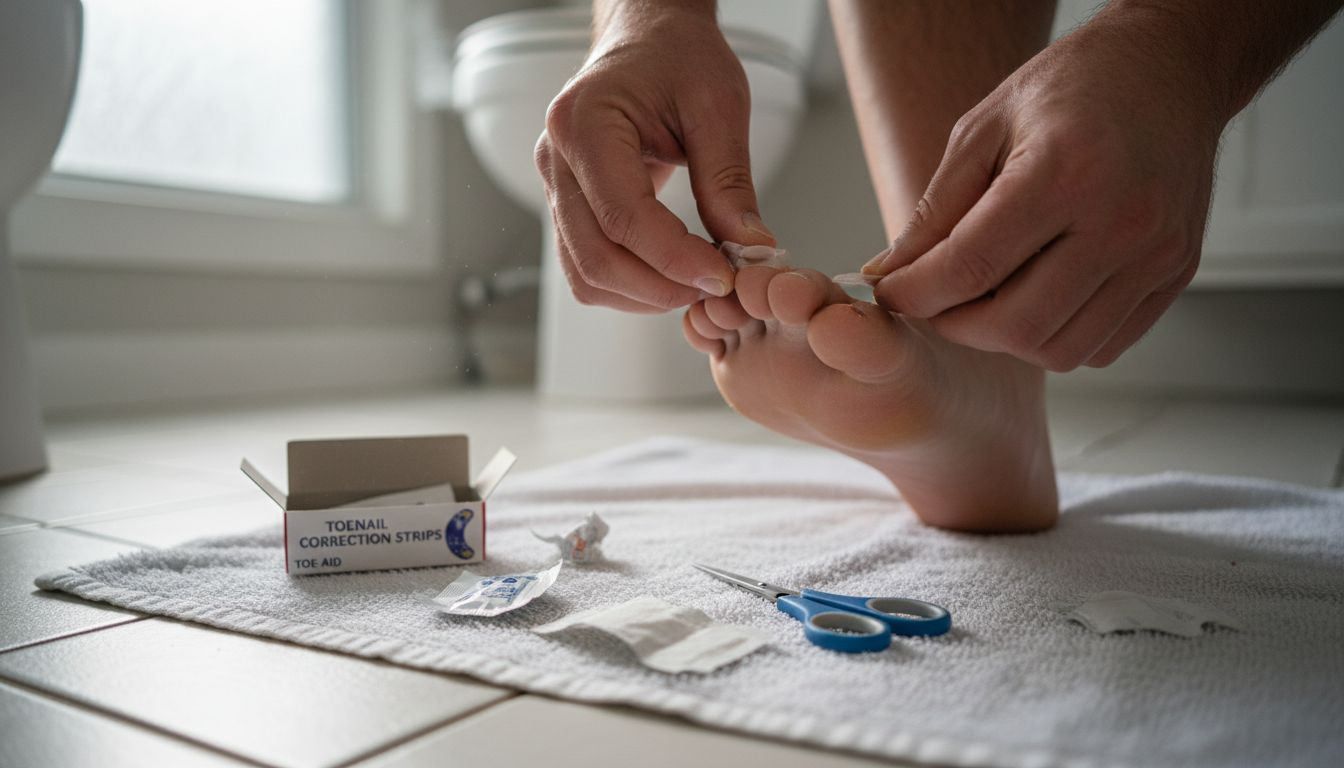
6. Toenail correction strips and braces
Correction strips (also called nail braces) are thin adhesive strips stuck on top of the nail. As they try to flatten, they gently lift the edges of a curved nail. Studies on nail braces show good results for both new and recurring ingrown toenails (nail brace study, 2019).
- Clean and dry the nail before applying.
- Follow the instructions on the pack.
- Replace every 3 to 5 days, or as the instructions say.
7. Tea tree oil
Tea tree oil is a well-studied natural antiseptic that acts against bacteria and fungi (Carson et al., 2006). It helps keep the skin around the nail clean while it heals. Always dilute it: undiluted tea tree oil can irritate skin.
- Mix 2 drops of tea tree oil into a teaspoon of coconut or olive oil.
- Dab it along the nail edge after soaking, twice a day.
- Not for babies or young children, and stop if the skin gets red or itchy.

My antiseptic for toes
Tea tree oil for an angry nail edge
Tea tree oil is the natural antiseptic I keep for feet: it acts against the bacteria and fungi that like warm, closed shoes. After an Epsom salt soak, a diluted drop along the nail edge keeps the area clean while the nail grows out.
- Pure Melaleuca alternifolia oil
- Always diluted: 2 drops in a teaspoon of coconut or olive oil
- Dab along the nail edge after soaking, twice a day
- Also our go-to oil for athlete’s foot and toenail fungus
Affiliate link: we may earn a small commission at no extra cost to you.
8. Apple cider vinegar soak
A traditional remedy for its mild antibacterial effect. Always diluted.
- Mix ½ cup of apple cider vinegar with a basin of warm water.
- Soak for 15 to 20 minutes, then dry well.
- Skip it if the skin is broken and it stings.
9. Turmeric and coconut oil paste
Turmeric is a traditional anti-inflammatory and antiseptic spice in Ayurveda. Mix ½ teaspoon of turmeric with a little coconut oil, dab it on the sore skin (not into an open wound), and cover with a plaster overnight. It stains, so use an old sock.
10. Open shoes and a toe protector
Pressure from shoes is one of the main reasons an ingrown toenail keeps hurting and keeps growing in. While it heals, wear open-toed sandals or wide, roomy shoes, and use a silicone toe cap or a small pad to take the pressure off. More on footwear and pressure in our calluses and corns guide.
How to Cut an Ingrown Toenail (and How Not To)
Cutting is where most ingrown toenails start, and where many get worse. How to clip your toenails safely:
- Cut straight across, without rounding the corners.
- Keep the length level with the tip of the toe, not shorter.
- Cut after a bath or soak, when the nail is softer.
- Use clean, sharp toenail clippers with a straight edge, and disinfect them after use.
- File any sharp corner lightly so it can’t spike into the skin.
- Don’t cut into the corner of an ingrown nail to “get it out”. It leaves a spike that grows back in deeper.
| Practice | Effect on the nail | OK if you’re prone to ingrown toenails? |
|---|---|---|
| Cutting straight across | Lowers the risk of ingrowth | Yes, preferred |
| Rounding the corners | Raises the risk of ingrowth | No, avoid |
| Clean, sharp clippers | Prevents ragged edges and infection | Yes, always |
| Digging out the corner | Can cut the skin and cause infection | Never |
| Gently filing sharp edges | Smooths spikes that dig into skin | Yes |
| Forcing the nail away from the skin | High risk of injury | Never |
How to Get an Ingrown Toenail Out
The honest answer: at home, you don’t cut it out, you lift it out. Soaking softens the nail, and lifting the corner with cotton, floss or tape guides it to grow over the skin instead of into it. The ingrown part then grows out on its own over a few weeks. If the corner is deeply embedded, very painful or infected, a podiatrist can remove the ingrown edge in a few minutes with a numbing injection, which is far safer than digging at it yourself.
Ingrown Toenail Infection
Signs of infection: more pain and swelling, warmth, pus or yellow fluid, a bad smell, bleeding, soft red tissue growing over the nail edge, red streaks spreading up the foot, or a fever.
While you arrange to see a podiatrist or GP: keep soaking in warm salt water 3 times a day, keep it clean and covered, and wear open shoes. Don’t squeeze pus out or cut into the skin. A Cochrane review found that antibiotics before nail surgery didn’t improve healing, and that removing the cause (the nail edge) is what matters (Rounding and Bloomfield, Cochrane, 2005). That’s why seeing a podiatrist about an infected ingrown toenail is about getting the nail edge treated, not just about pills.
If you have diabetes, poor circulation or numbness in your feet, don’t treat an infected toe at home: see a professional the same day. See also numbness in hands and feet.
Ingrown Toenail Surgery
For an ingrown toenail that keeps coming back or is badly infected, a podiatrist or doctor can do a small procedure under local anaesthetic: they remove the ingrown strip of nail, and often treat the nail root on that side so it doesn’t grow back. A Cochrane review found that partial nail removal combined with treating the nail root (with phenol) works better at preventing the problem coming back than surgery alone (Cochrane, 2005). Recovery is usually quick: most people walk out in normal shoes or sandals and are back to normal within a couple of weeks. Keep the toe clean and dry and soak it as advised afterwards.
How to Prevent an Ingrown Toenail
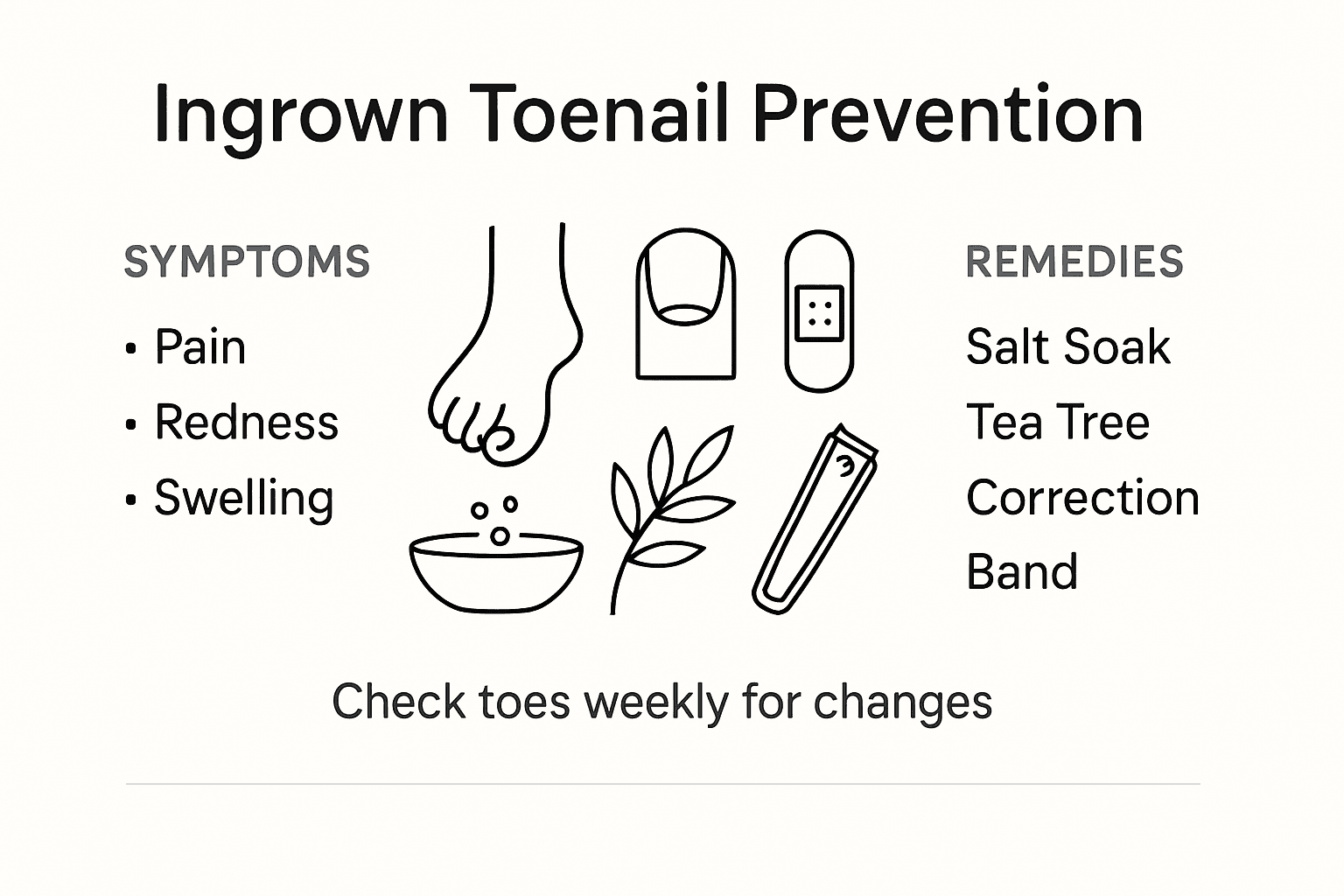
- Cut straight across and not too short.
- Wear shoes with a wide toe box, and don’t wear shoes that press on your toes.
- Protect your toes in sports and at work (steel-toe shoes if heavy objects can fall).
- Keep feet dry: change sweaty socks and let shoes air out. See also athlete’s foot home remedies.
- Check your feet weekly, especially if you have diabetes, so you catch problems early.
- Use a correction strip if your nails are naturally very curved and keep growing in.
Pro tip: keep a small foot-care kit together: straight toenail clippers, a file, Epsom salt, cotton and tea tree oil. When you feel the first tenderness, start the soaks that same evening.
Ingrown Toenail or Toenail Fungus?
An ingrown toenail affects the side of the nail and the skin next to it: red, swollen and painful. Toenail fungus changes the nail itself: thick, yellow or white, crumbly and brittle, usually without pain at first. The two can happen together, because a thick fungal nail is more likely to press into the skin. For fungal nails, see our toenail fungus home remedies.
Ingrown Toenails in Children and Teens
Teenagers get ingrown toenails often, because their feet grow fast and they wear tight sports shoes. The same gentle approach works well in children (conservative treatment in children, 1999): warm soaks, cotton under the corner, roomy shoes and teaching them to cut their nails straight across. Use tea tree oil only well diluted, and see the doctor for any sign of infection. For an ingrown nail on the hand, see our guide to an ingrown fingernail.
Related Foot Guides
- Home remedies for calluses and corns (our main hands and feet guide)
- Toenail fungus home remedies
- Athlete’s foot home remedies
- How to treat blisters on feet
- Cracked heels home remedies
- Home remedies for sore feet
Frequently Asked Questions
What is the best home treatment for an ingrown toenail?
Warm Epsom salt soaks for 15 to 20 minutes three times a day, then lifting the corner with a wisp of cotton or dental floss, open shoes, and keeping the toe clean. Most mild cases improve within 1 to 2 weeks.
Does Epsom salt help an ingrown toenail?
Yes. A warm Epsom salt soak softens the nail and skin, eases swelling and pain, and makes it easier to lift the nail corner. Use ¼ cup in a basin of warm water for 15 to 20 minutes.
Will an ingrown toenail go away on its own?
Very mild ones sometimes do, but most need help: soaks, lifting the corner and taking the pressure off. If it’s worse after 3 to 5 days, or shows signs of infection, see a podiatrist.
How do you cut an ingrown toenail?
Don’t cut into the ingrown corner. Cut toenails straight across, level with the tip of the toe, after soaking, and lift the corner with cotton instead. A podiatrist can safely remove a deeply ingrown edge.
How do I know if my ingrown toenail is infected?
Increasing pain, swelling and warmth, pus, a bad smell, red tissue growing over the nail, red streaks or a fever. See a podiatrist or GP promptly, and the same day if you have diabetes.
How do you relieve the pain of an ingrown toenail?
Soak it in warm salt water, lift the corner with cotton, wear open or wide shoes and protect the toe with a silicone cap. The pain usually eases within a day or two once the pressure is off.
Does tea tree oil help an ingrown toenail?
Tea tree oil is a natural antiseptic that helps keep the area clean. Mix 2 drops in a teaspoon of carrier oil and dab it along the nail edge after soaking. Don’t use it undiluted.
How do you stop ingrown toenails coming back?
Cut nails straight across and not too short, wear shoes with room for your toes, keep feet dry, and use a correction strip if your nails are naturally curved. If they keep coming back, a podiatrist can treat the nail edge permanently.
Recommended
- Home Remedies for Calluses and Corns
- Toenail Fungus Home Remedies
- How to Treat an Ingrown Fingernail
- Athlete’s Foot Home Remedies
- More natural home remedies
Some links on this page are affiliate links, marked as such. If you buy through them, we may earn a small commission at no extra cost to you. This article is for general information and does not replace a diagnosis from a qualified professional. Read our medical disclaimer or browse more natural remedies.
